

Best AI Model for Marketing in 2026: How to Choose, What to Use, and Where VerticalResponse Fits

There is no single best AI model for marketing in 2026. The landscape has fragmented into specialized tools, each excelling at different jobs: writing email copy, predicting customer behavior, generating visuals, and optimizing send times. For small businesses and nonprofits, the real question is not which model has the highest benchmark score but which combination of AI, data, and automation delivers measurable results inside the tools you already use.
This guide breaks down every major category of AI model used in marketing today, explains how each one fits into real workflows, and shows you where to start if you want better email performance, lower costs, and more time for strategic work.
Key Takeaways
- There is no universal best AI model for marketing. Different models excel at copywriting, audience segmentation, creative asset generation, and predictive analytics. Smart marketers mix them rather than betting on one.
- For small businesses and nonprofits, the fastest path to results is using AI marketing tools already built into platforms like VerticalResponse, not building custom models or juggling standalone apps.
- Marketing leaders should optimize for outcomes-higher open rates, better click-through rates, lower customer acquisition cost-rather than raw AI benchmarks or model architecture names.
- Combining AI models with marketing automation (workflows, triggers, and lightweight AI agents) is what unlocks the biggest gains in email marketing. The model alone is not enough.
- Data quality, integration with your existing stack, and clear brand voice rules matter far more than which specific model powers the tool behind the scenes.
What “Best AI Model for Marketing” Really Means in 2026
Most people searching for the best AI model for marketing want a simple answer: “Use this one.” The reality is more nuanced. The right question is: “Which model is best for this specific job, with my data, at my scale?”
An AI model is the engine behind the tools you use. GPT-4.1 from OpenAI, Claude 3.5 from Anthropic, Gemini 1.5 from Google, and the open-source LLaMA 3 from Meta are all large language models (LLMs) trained on massive text datasets. Each has different strengths in areas like context length, cost, speed, and safety. GPT-4.1, for example, supports up to one million tokens of context, meaning it can “remember” your entire campaign history while generating new copy.
Marketing use cases span email, SEO, paid ads, analytics, creatives, AI avatars, customer support, and more. No one model tops every category. Effective AI models act as reasoning engines and research assistants in marketing, helping you think at scale rather than replacing your judgment. The modern marketing AI landscape focuses on strategic thinking at scale, not just automating individual tasks.
What matters most for marketers is not the model name but the quality of customer data flowing into it, the integrations connecting it to your channels, and the workflows that act on its outputs. This article focuses on practical choices for small to mid-sized marketing teams, with examples tied back to email and lifecycle marketing.
Core Types of AI Models Used in Marketing Today
Different AI model types map to different marketing tasks. Here is how the landscape breaks down.
Large language models (LLMs) for text
Models like GPT-4.1, Claude 3.5, Gemini 1.5, and LLaMA 3 handle text generation, content creation, and ideation. Large Language Models enhance marketing strategies through understanding context and semantics, making them well-suited for drafting email copy, brainstorming topics, generating AI-produced subject lines, and structuring campaign narratives. Modern AI models are multimodal and task-specialized for different marketing functions, which means newer LLMs can also process images and documents alongside text. For a deeper dive into the leading options, see our guide to the top 5 AI models for email marketing in 2026.
Vision and multimodal models
Generative AI can produce high-quality visuals without a design team, using diffusion-based models (like Stable Diffusion and Midjourney-style tools) or the vision capabilities built into GPT-4.1 and Gemini. These power ad creatives, social tiles, email hero images, and product mockups. Multimodal models generate or edit visuals and integrate with documentation, enabling content production that spans both text and imagery in a single workflow.
Recommendation and propensity models
Behind most ESPs, CDPs, and CRM systems sit machine learning models-gradient-boosted trees, random forests, deep neural nets-that predict churn risk, purchase likelihood, optimal send times, and link click probability. These are rarely visible to marketers but drive features like smart send-time, product recommendations, and dynamic segmentation.
Specialized models for speech, avatars, and conversational AI
Voice agents, AI avatars, and chatbots are increasingly common for customer support and onboarding. AI-driven chatbots can respond to customer queries instantly, and conversational AI improves customer support and creates personalized user journeys. These are typically accessed through tools rather than raw APIs, so most teams interact with them as features, not as standalone models.

How AI Models Actually Plug Into Marketing Workflows
Most marketers never call a raw API. They use AI marketing tools that wrap models with a user interface, data connections, and automation logic. Here is the typical flow:
- Data in: Customer data from your CRM, email lists, web analytics (like Google Analytics), and surveys feeds into the system.
- AI inference: The model processes that data-generating copy, scoring contacts, recommending send times.
- Orchestration: Automation workflows, triggers, and rules route outputs to the right actions.
- Channel execution: Emails, social media posts, paid ads, and landing pages go live.
- Feedback loop: Opens, clicks, conversions, and unsubscribes flow back in, refining the next round.
AI models ingest proprietary data through uploaded files or vector databases, meaning your past campaigns, customer segments, and brand guidelines can inform every output. Core mechanical features of AI in marketing include contextual memory and RAG (retrieval-augmented generation), which allow models to reference your specific content library rather than relying only on their general training data.
Concrete example: A VerticalResponse user sets up an automated welcome series where AI generates variant subject lines and email body copy, A/B tests them across the first few hundred sends, and reports which version wins. Subsequent emails in the sequence adapt based on whether the subscriber clicked or ignored the first message.
The distinction between AI powered features (smart send-time, copy suggestions) and full AI agents that run sequences of tasks with minimal oversight matters here. Most small businesses benefit from features, not fully autonomous agents. Choosing the best AI model for marketing is really choosing the best stack of model, data, and automation for your team’s size and sophistication.
Best AI Models for Marketing Copy and Email Campaigns
Text generation remains the number-one marketing use case and the most directly relevant to email marketing. General-purpose LLMs provide fluent copy and consistent tone across marketing channels, but each model brings different strengths to the table.
GPT-4.1 excels at instruction following, long-context campaigns (referencing your entire send history), and maintaining consistent brand voice across multi-email flows. Its lower latency and cost compared to earlier GPT-4 variants make it practical for high-volume content generation.
Claude 3.5 (Sonnet/Haiku) is often cheaper per token and includes strong safety and compliance features, making it a good fit for regulated industries or nonprofit donor communications. For a detailed comparison, see our breakdown of OpenAI vs Claude for small business email marketing.
Gemini 1.5 shines when tasks involve multimodal inputs or multilingual support-useful for international businesses or campaigns that combine text, images, and documents.
For email marketing specifically, prioritize models that handle short, conversion-focused copy well. Email subject lines, CTAs, and preview text deliver outsized impact on opens and click-through rates. AI tools enable hyper-personalization at scale for marketing campaigns, and generative AI can create personalized messaging for different audience segments-meaning a single prompt can produce different versions of the same offer for different customer groups. AI can personalize messaging for different audience segments without requiring separate campaigns.
Platforms like VerticalResponse can embed these LLMs directly into the editor, letting you generate subject lines, preheaders, and body variants without leaving the tool. For small businesses, relying on integrated AI features in your email platform is far simpler-and usually more effective-than juggling multiple standalone AI writing tools.
Best AI Models for Audience Segmentation and Predictive Targeting
Better copy helps, but segmentation and prediction-deciding who to email, when, and with what offer-often deliver higher ROI. A DTC brand with $4 million in revenue climbed its email revenue share from 15% to 34% by layering behavior-based segmentation, send-time optimization, and personalized content, increasing its open rate from 18% to 31% and CTR from 2.1% to 4.8%.
Typical predictive models used in marketing include:
- Churn/inactivity prediction: Identifies subscribers likely to disengage, triggering re-engagement paths.
- Lead scoring: Estimates likelihood of purchase or, for nonprofits, likely donation amount.
- Purchase propensity: Predicts who is most likely to buy soon, guiding cross-sell timing.
- Optimal send-time modeling: Determines when each individual is most likely to open or click.
Predictive analytics models enable data-driven marketing decisions and targeting. Marketers benefit from predictive models that identify high-value segments and behaviors, and these models help identify patterns that hint at future outcomes. Under the hood, many are gradient-boosted machines or deep learning models embedded in ESPs, CDPs, or analytics platforms-not something you need to build yourself.
AI can analyze customer behavior to enhance engagement strategies, and AI tools help brands create tailored experiences based on audience signals. Generative AI can analyze audience behavior for content recommendations, closing the loop between “who should receive this” and “what should they receive.” AI tools enable hyper-personalized content recommendations at scale, which is especially powerful for email list segmentation.
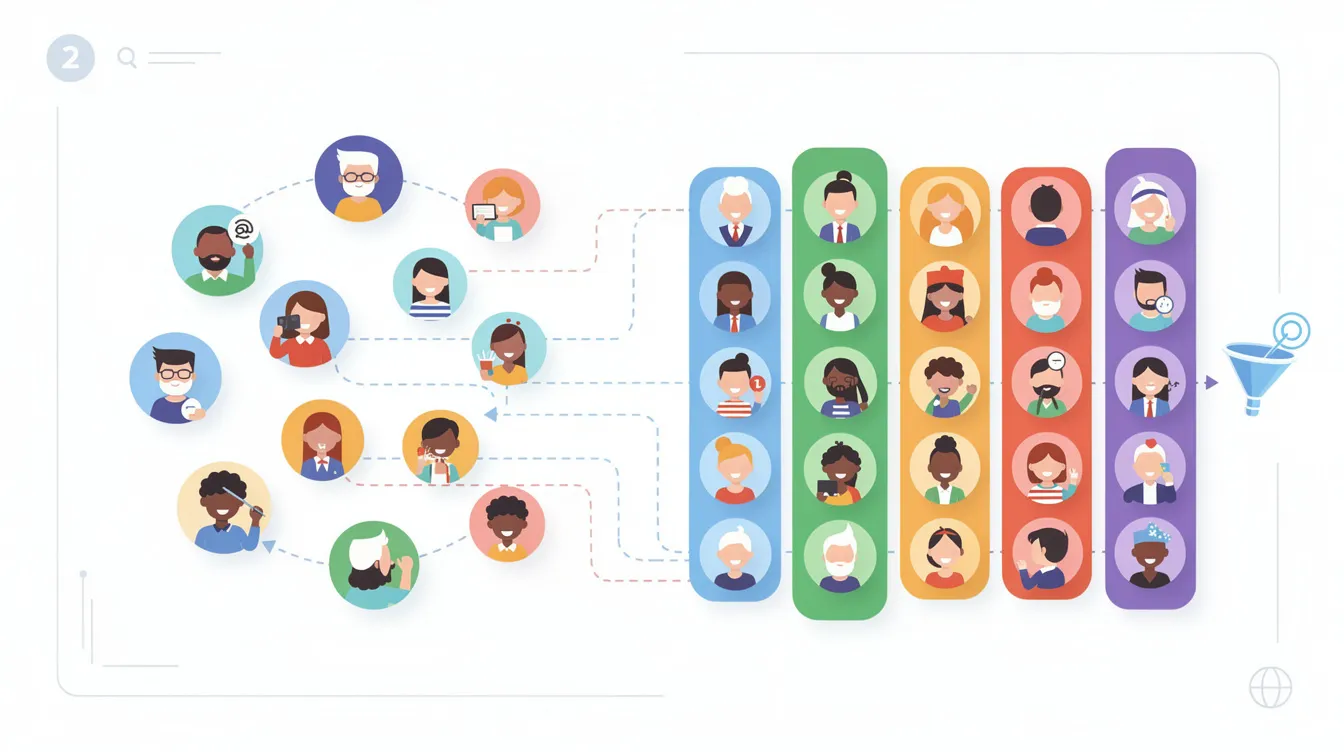
VerticalResponse can use engagement history-opens, clicks, survey responses-to feed AI-driven segmentation that decides which automation path a subscriber enters. The best AI here is whichever model is closely integrated with your list data and easy to act on via campaigns and automations.
Best AI Models for SEO, Content, and AI Search Visibility
The concept of the best AI model for marketing now extends beyond email into how your brand shows up in AI search. Search is shifting toward AI-generated overviews in Google and Bing, making branded search and traditional SEO only part of the picture. If your content is not structured for AI answers, you lose better visibility in these emerging channels.
LLMs help with keyword clustering, outline generation, meta descriptions, and FAQ ideas aligned with both SEO and AI-powered overviews. AI can analyze large datasets to identify emerging marketing trends, giving you an edge in choosing which topics to pursue. Established tools like SurferSEO and Clearscope already wrap models to optimize content for entities, intent, and on-page structure.
When choosing a model for content generation, favor those that handle long context-entire pillar pages, content calendars-to maintain consistency and avoid duplication. AI-generated captions can be tailored for specific social media platforms, meaning the same core content can be repurposed across channels with platform-appropriate formatting.
The email marketing tie-in is direct: use the same models to repurpose search-optimized blog posts into newsletters and email drip sequences with minimal manual rework. Generative AI can produce weeks’ worth of content in minutes, letting you brainstorm topics, draft articles, and spin off email versions in a single session. This bridges your social media marketing, content creation, and email efforts without requiring separate tools for each.
Best AI Models for Creative Assets: Images, Video, and AI Avatars
Visual models support brand marketing across social ads, email hero images, banners, and AI avatars for tutorials or onboarding. AI tools can generate high-quality visuals without a design team, which is a game-changer for small marketing teams that lack dedicated designers.
What marketers care about is brand consistency, speed, and license clarity-not model internals. Stability AI’s models (SD3, SDXL) are available under a Community License that allows free commercial use for businesses under $1 million in revenue; above that, an enterprise license is required. Midjourney grants ownership of generated images to creators under paid subscriptions, though legal questions about training data remain in flux.
AI can automate the generation of product mockups and lifestyle imagery, and short-form videos can be created from text prompts in minutes. These capabilities power explainer clips, product demos, and personalized onboarding videos. Multimodal models generate or edit visuals and integrate with documentation, streamlining the creative pipeline.
AI-generated visuals can be embedded directly in email campaigns and landing pages built with VerticalResponse, speeding up design cycles for teams that would otherwise wait days for a freelancer. But governance matters: keep visual style guides and brand rules so generated assets stay on-brand. Without constraints, style drift is real and can dilute brand consistency across channels.
AI Agents vs Single-Use AI Tools in Marketing
AI agents are goal-driven systems that chain multiple AI calls and tools together, versus single-prompt generators that produce one output at a time. Agentic workflows allow marketing agents to execute tasks autonomously-for instance, monitoring campaign performance, triggering A/B tests, and adjusting send schedules without manual intervention. For a deeper explanation, see our guide to agentic AI for marketers.
Examples of agentic AI in marketing:
- Weekly campaign performance summaries with actionable recommendations
- Automated A/B test setup based on real time insights from prior sends
- Re-engagement campaigns triggered by subscriber inactivity
However, most teams-especially small businesses-are best served by lightweight, guardrailed agents embedded in platforms rather than fully autonomous systems. The learning curve for managing fully autonomous agents is steep, and the risks (sending to wrong segments, misallocating budget shifts) are real.
Marketers should keep humans in the loop for list changes, major segmentation decisions, or large budget shifts. VerticalResponse’s automation features function as a practical orchestrated layer where AI suggests and routes, but marketers stay in control of decision making.
How to Evaluate AI Models for Your Marketing Stack
Selection should be based on business goals and constraints, not hype or benchmark charts. Here are the key evaluation criteria:
| Criterion | What to Ask |
|---|---|
| Output quality | Does the model produce good copy, segmentation, or visuals for my channels? |
| Latency/speed | How fast are results returned? Can it handle real-time triggers? |
| Cost per 1,000 calls | What is the total cost including API fees, compute, and hidden charges? |
| Data privacy | Where does my data go? Are DPAs in place? |
| Integration | Does it plug into my ESP, CRM, or analytics platforms without custom engineering? |
| Feedback loops | Can I feed results back to improve outputs over time? |
AI models should support integration with existing tech stacks for optimal use. Effective marketing AI setups combine LLMs, proprietary data, predictive analytics, and experimentation-not just a single prompt. AI attribution tools analyze entire customer journeys, assign credit across multiple touchpoints (not just one), adapt based on data over time, work with incomplete data effectively, and provide a neutral layer consolidating data across platforms. They consolidate data from multiple accounts and channels into actionable insights.
Lean toward AI embedded in your ESP or CRM to avoid custom engineering and vendor sprawl. Run practical tests: subject line uplift, click-through rate changes, time saved in content production-not just “does the copy sound nice.” Model performance shifts over time, so re-evaluate at least annually or when major new releases land.
Choosing the Best AI Model by Marketing Use Case
Rather than obsessing over one model, match the right tool to each marketing function:
- Email copy and nurtures: LLMs with strong instruction-following (GPT-4.1, Claude 3.5). Use integrated features in your ESP to generate different versions of subject lines and body copy.
- SEO long-form content: LLMs with large context windows to maintain consistency across pillar pages and supporting articles.
- Paid ad variants: Multimodal models that generate ad variants-text plus visuals-for testing across ad platforms.
- Social content: AI-generated captions tailored for specific social platforms, repurposed from your email or blog content to strengthen social media presence.
- Analytics and attribution: Tabular ML models (gradient-boosted trees) inside analytics platforms and CDPs for data analysis and customer journey mapping.
- Customer support chat: Conversational AI and chatbot models for instant responses and personalized user journeys.
In a platform like VerticalResponse, marketers choose features (“optimize send time,” “generate copy”) rather than directly choosing models. The vendor curates the stack. For nonprofits and small businesses, simplicity and predictable workflows beat exotic, cutting-edge models that require in-house data science.
Data, Privacy, and Compliance When Using AI in Marketing
Artificial intelligence in marketing must respect GDPR, CCPA, and email consent rules. Trust is non-negotiable, especially for nonprofits handling donor data.
AI performance relies on the cleanliness and relevance of first-party customer data. Dirty data produces poor predictions, irrelevant copy, and wasted sends. Before scaling AI, invest in list hygiene and data accuracy.
Most marketers will not train foundation models on customer data. Instead, they send prompts and context to hosted models. Best practices include:
- Avoid pasting raw PII into public AI tools
- Use vendor features that mask or tokenize data
- Rely on platforms that sign Data Processing Agreements (DPAs)
- Keep consent management and unsubscribe compliance intact
VerticalResponse already manages list consent, unsubscribes, and compliance. AI features should sit on top of these safeguards, not bypass them. Align legal, IT, and marketing when rolling out AI tools, especially in regulated or nonprofit donor contexts.
AI Marketing Tools vs Underlying AI Models
There is an important distinction: tools are what marketers buy, while models are what those tools run behind the scenes. When you use an AI marketing tool to draft an email or score a lead, you are interacting with a curated experience-not a raw model.
Many leading marketing platforms now use multiple AI models: one for language, one for recommendations, one for anomaly detection. You do not need to manage API keys for every model. Instead, choose vendors that evolve their model choices over time as technology improves.
VerticalResponse is an example of an AI powered email marketing platform that can upgrade its internal models without forcing customers to rebuild workflows. The right tool abstracts away model complexity so you can focus on strategy, not infrastructure.
When evaluating vendors, ask about model update policies, data handling, and roadmap-rather than asking “Do you use model X or Y?” in isolation. One tool that wraps multiple models well will outperform trying to stitch together separate services yourself.
Where AI Delivers the Fastest Wins for Small Businesses and Nonprofits
Skip the visionary hype. Here are the concrete, near-term wins that deliver results in the first 90 days:
1. Email subject line optimization A coaching business saw open rates jump from 18% to 41%-a 128% increase-simply by using AI to generate and test better subject lines. Generative AI improves click-through rates by tailoring content to what each segment responds to.
2. Automated follow-up sequences Welcome series, cart abandonment, and re-engagement flows are routinely among the highest-ROI email use cases. Marleylilly achieved 33–49% conversion rates on abandonment flows using AI-powered audience segmentation and send-time optimization.
3. List cleanup and segmentation AI can analyze audience behavior to recommend tailored content variations and flag inactive contacts for re-engagement or removal, improving deliverability and reducing send costs.
4. Content production at speed A solo founder reduced newsletter drafting from five to six hours down to about 45 minutes using AI tools. AI can produce weeks’ worth of content in one sitting, freeing time for strategic work and customer engagement.
5. Survey analysis and personalization Using customer survey responses to segment lists and personalize messaging creates a direct connection between what customers say and what they receive. Personalized marketing can significantly increase customer retention rates.
VerticalResponse customers can start with built-in AI copy suggestions and automation templates instead of building bespoke systems. Track opens, clicks, and time saved per campaign as your primary KPIs.

Limitations and Risks of Relying on AI Models in Marketing
AI is powerful but imperfect. It should complement-not replace-marketer judgment.
Hallucinations and inaccuracies: LLMs sometimes invent statistics, fabricate testimonials, or misrepresent product features. Every piece of AI-generated copy must be reviewed by a human before sending. This is non-negotiable for customer-facing campaigns.
Brand voice drift: Without clear guardrails, AI may slowly change your tone, especially when multiple people use AI tools without a shared prompt library. Brand-voice specialized models assist with consistent brand language and messaging, but they still need human-defined style guides to stay on track.
Over-automation risks: Sending too frequently, ignoring unsubscribe cues, or reactivating cold contacts without consent can damage deliverability and trust. AI should make your customer experience better, not just louder.
Simple governance practices:
- Require approval flows before any AI-drafted campaign goes live
- Maintain a content checklist covering accuracy, tone, compliance, and consent
- Set clear rules for when humans must intervene-especially around lead quality changes, list modifications, and major campaign pivots
Building an AI-Driven Email Marketing Operating Model with VerticalResponse
Bringing together AI models, automation, and VerticalResponse’s focus on email, landing pages, and surveys creates a practical operating model for small teams.
Phase 1: AI-assisted drafting Start with AI-generated subject lines, preheaders, and body copy. Use a single prompt with your brand voice guide and a few examples of past winning emails to get consistent outputs. Generative AI can produce weeks’ worth of content in minutes, giving you a backlog of variants to test.
Phase 2: AI-informed automations Layer in automated welcome series, re-engagement flows, and post-purchase sequences. These automations use AI to route subscribers into the right path based on user behavior and engagement history. This is the next phase where AI moves from drafting assistant to active campaign participant.
Phase 3: Predictive segmentation Where available, add predictive scoring-churn risk, purchase propensity, optimal send time-to further refine who gets what message and when.
Reuse AI-generated content across email, landing pages, and social updates while keeping lists and messaging consistent inside VerticalResponse. Reporting and surveys feed back into your prompts and targeting, creating a simple but powerful feedback loop that improves results over time.
Document your prompts, brand voice rules, and winning variants. This library becomes your competitive advantage as AI outputs grow more consistent with each iteration.
Future Trends: Agentic Marketing, AI Search, and Beyond
Over the next two to three years, expect more agentic systems that autonomously adjust email frequency, test new landing pages, and sync with social platforms and ad platforms based on performance signals. AI agents will move from novelty to standard practice for most teams.
AI search will reshape top-of-funnel marketing. Being visible in AI-generated answers and overviews-not just traditional SEO rankings-will require structured, authoritative content. Marketers should think about how AI answers surface their brand, not just how Google ranks their pages.
Cross-channel orchestration will tighten. The gap between email, SMS, social media, and paid ads will shrink as AI orchestration layers unify decision making across channels based on real time insights.
Small teams do not need to chase every trend. Focusing on solid email foundations plus AI for efficiency will stay valuable regardless of how search interfaces change. Vendors like VerticalResponse will handle most of the model-level changes, letting marketers focus on strategy and relationships. For a broader look at what is coming, see our piece on the future of email marketing for small businesses.

Putting It All Together: How to Decide Your “Best AI Model for Marketing” Plan
There is no universal best AI model for marketing. There is a best approach for your goals, budget, and channel mix.
A simple 3-step decision path:
- Clarify goals. What outcome matters most-better email ROI, faster content production, improved segmentation, or lower acquisition cost?
- Choose primary tools. Pick an ESP, CRM, and analytics platform with strong built-in AI features. Look for platforms that handle model updates without forcing you to rebuild workflows.
- Pilot 2–3 focused use cases. Start with email subject line optimization, an automated welcome or re-engagement sequence, and basic AI-driven segmentation. Measure results over 90 days.
Favor stable, well-supported platforms like VerticalResponse over chasing individual model releases or building from scratch. Set clear success metrics: lift in opens, lift in clicks, time saved per campaign.
Audit your current marketing stack today. Identify where AI models-especially within email marketing-can create immediate impact. Start with the right tool, feed it clean data, and let the results guide your next move.
FAQ: Best AI Model for Marketing
Is there one AI model I can standardize on for all my marketing?
While many marketing teams try to standardize on a single provider for simplicity, in practice different tools will use different models under the hood. Your email platform might use one model for copy suggestions and another for send-time predictions. The smarter approach is to standardize on platforms and workflows-your ESP, CRM, and analytics stack-rather than obsessing over one universal model. This way, you benefit from the best model for each task without managing the complexity yourself.
Do I need to train my own custom AI model on my marketing data?
Most small and mid-sized businesses do not need to train proprietary AI models. Fine-tuning or prompt engineering on top of strong base models, delivered through your existing tools, is almost always sufficient and far more cost-effective. Training a foundation model requires significant data science expertise, compute costs, and ongoing maintenance. Instead, focus on providing clean, well-organized customer data to your existing tools and crafting strong prompts that reflect your brand voice and goals.
How can I tell if an AI model is actually improving my campaigns?
Run controlled A/B tests comparing AI-assisted campaigns with human-only baselines. Track specific metrics: open rate, click-through rate, conversion rate, and time spent on campaign production. Evaluate results over at least several sends to smooth out noise from individual campaigns. A meaningful test might involve sending AI-generated subject lines to half your list and your manually written versions to the other half, then comparing performance over two to four weeks.
Will using AI in email marketing hurt my deliverability?
AI itself does not harm deliverability. Problems arise from poor sending practices that AI can enable if left unchecked-over-mailing, targeting disengaged subscribers, or generating spammy wording. Stick to list hygiene and permission best practices, use AI as a drafting and optimization assistant rather than a volume amplifier, and always respect unsubscribe signals. When used responsibly, AI typically improves deliverability by helping you send more relevant content to engaged subscribers.
How do I keep my brand voice consistent when multiple people are using AI tools?
Create a shared brand voice guide that includes tone descriptors, example phrases, words to avoid, and sample prompts that reliably produce on-brand outputs. Store these as templates inside your platform so every team member starts from the same foundation. Periodically review recent campaigns to catch drift and update your prompt library as your brand evolves. The goal is making consistency the default, not something each person has to reinvent with every send.
© 2026, Vertical Response. All rights reserved.




 Features
 Pricing
 Partner
 Blog
 Support
 More resources
 Terms of Services
 Privacy Policy