
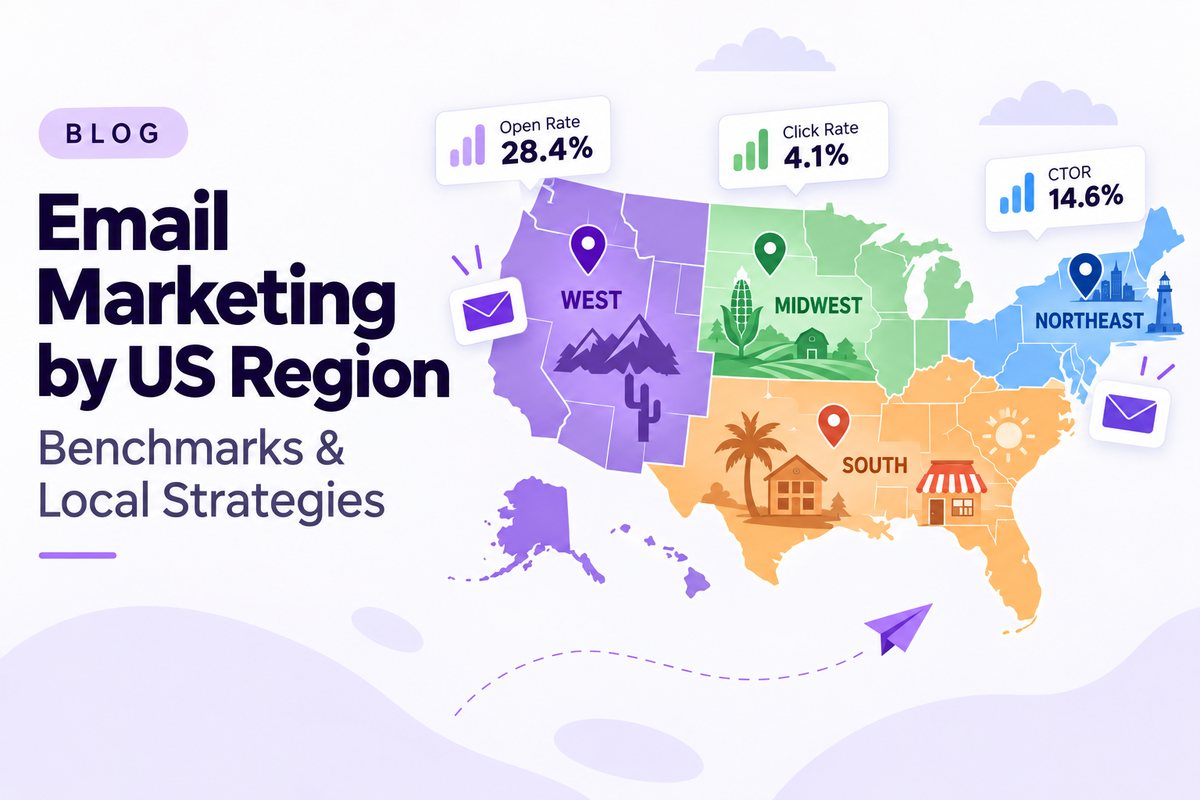
Email Marketing by US Region: Benchmarks, Tactics, and Location-Based Strategies

Key Takeaways
- Email marketing strategies vary significantly across different regions in the U.S. The Northeast, South, Midwest, and West each show distinct patterns in open rate, click rate, click-to-open rate, bounce rate, and unsubscribe rate due to differences in device usage, industry mix, and subscriber behavior.
- Based on 2024–2025 industry data, the average email open rate in 2025 was 43.46%, the average email click rate was 2.09%, and the median unsubscribe rate across all campaigns was 0.22%. Each US region can sit slightly above or below these benchmarks depending on audience composition.
- Location based email marketing using stable customer data like ZIP code, city, and state lets small businesses tailor email campaigns to local weather, sports, holidays, and store locations, driving measurably higher engagement. Segmentation can lead to a 760% increase in revenue.
- Apple Mail Privacy Protection and Gmail’s one-click unsubscribe change how open rate and unsubscribe rate should be interpreted. Click rate and click-to-open rate are now more reliable metrics for optimization, especially in iPhone-heavy regions.
- VerticalResponse provides built-in segmentation, email automation, regional performance reports, and tools for local offers, surveys, and landing pages designed specifically for US small businesses and nonprofits.
Introduction: Why US Regional Email Marketing Matters in 2026
Email marketing remains one of the most effective marketing channels available, delivering an average ROI of $36 for every dollar spent. But treating the entire United States as a single audience is a missed opportunity. Consumer preferences can vary substantially by city, state, and region, and that means your email marketing strategy needs to account for where your subscribers actually live and work.
This article breaks down email benchmarks by US region-Northeast, South, Midwest, and West-and shows how location based email marketing tactics can help small businesses and nonprofits send emails that feel locally relevant. VerticalResponse works with thousands of US-based organizations, and we’ll use that lens throughout without turning this into a product pitch.
How US Regional Email Benchmarks Are Collected and Interpreted
Major benchmark reports from 2024–2025 draw on data from hundreds of thousands of accounts and billions of messages to calculate performance averages. Platforms like Omnisend analyzed over 27,000 brands and roughly 20 billion emails, while MailerLite published industry-specific figures from millions of campaigns. These global and US & Canada figures serve as a starting point that email marketers can then narrow to US regions using proxy data like device usage, industry concentration, and audience demographics.
Here are the key metrics this article tracks:
- Email open rate: Unique opens ÷ emails delivered
- Click rate (click-through rate): Link clicks ÷ emails delivered
- Click-to-open rate (CTOR): Link clicks ÷ unique opens
- Email bounce rate: Failed deliveries ÷ total sent (hard + soft)
- Unsubscribe rate: Opt-outs ÷ emails delivered
- Spam complaint rate: Complaints ÷ delivered (typically under 0.1%)
One critical caveat: post-2021 Apple Mail Privacy Protection inflates open rates in iOS-heavy regions (West Coast metros, affluent Northeast cities) by pre-fetching tracking pixels regardless of whether the subscriber actually reads the email. Gmail UI changes since 2023 also make unsubscribing easier, nudging unsubscribe rate upward. For practical decision-making, most marketers now rely on click rate, click-to-open rate, and downstream conversions rather than open rate alone when comparing regions.
US & Canada Benchmarks as a Starting Point
Before zooming into US regions, it makes sense to anchor expectations against US & Canada combined benchmarks from the past year. These serve as the baseline every regional figure will be measured against.
Typical 2024–2025 ranges for US & Canada email campaigns:
| Metric | Approximate Range |
|---|---|
| Email open rate | 43–45% |
| Click rate | 2.0–2.2% |
| Click-to-open rate | 6.5–7.0% |
| Unsubscribe rate | ~0.22% |
| Email bounce rate | 0.5–0.7% |
For context, the highest email open rate by industry was 55.71% for religion, while the industry with the highest email click rate was legal at 4.90%. These US & Canada averages tend to run slightly higher than Latin American benchmarks and sit close to Australia and Western Europe, reflecting relatively strong subscriber engagement across North America. Nonprofits frequently outperform these baselines-MailerLite reports a nonprofit median open rate around 53.21%.
The rest of this article adjusts these expectations for each specific US region.
Regional Email Performance in the United States: Overview
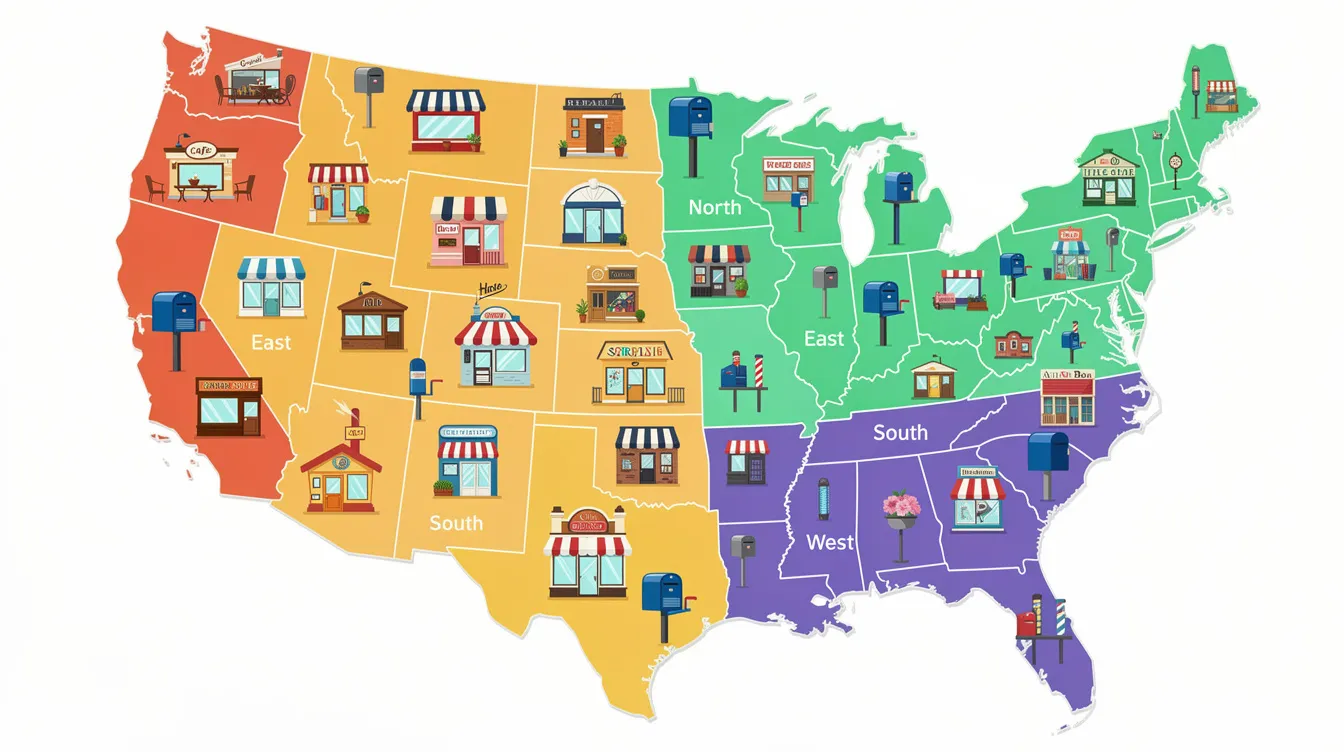
This article uses four major US regions: Northeast, South, Midwest, and West. Cultural, economic, and device-usage differences across these areas meaningfully affect email marketing performance.
High-level directional differences include:
- Urban coastal markets (Northeast metros, West Coast cities) often show higher measured open rates partly because of iPhone saturation and Apple MPP inflation.
- Some Southern and Midwestern markets may produce stronger click-to-open rates because subscriber lists tend to be more selective and inboxes less competitive.
- Urban versus rural dynamics impact email strategies significantly by emphasizing different values-dense metro areas favor convenience and speed, while rural audiences respond to community and practicality.
While differences in open and click rates between US regions are often only a few percentage points, those gaps matter for realistic goal-setting. A nonprofit in the Midwest will have different email benchmarks than an e-commerce brand in the Northeast, so region-level data should always be combined with industry-level context.

Email Benchmarks for the US Northeast
The Northeast region-New York, New Jersey, Massachusetts, Pennsylvania, and surrounding states-has high digital adoption, heavy mobile device usage, and some of the most saturated inboxes in the country. Email marketing timing is influenced by the U.S. spanning multiple time zones, and engagement peaks in this region tend to align with local commuting habits, particularly the morning subway and train commute.
Directional benchmark guidance for the Northeast:
| Metric | Northeast Range |
|---|---|
| Email open rate | Mid-40% to high-40% |
| Click rate | ~2.3–3.0% |
| Click-to-open rate | ~6–8% |
Common industries here-finance, education, healthcare, professional services, and non profits-tend to generate strong subscriber engagement, particularly with nonprofit newsletters in the Boston and New York philanthropy scenes. High-cost coastal markets generally respond well to premium positioning and luxury upgrades in email content.
Practical tactics for the Northeast:
- Send during morning commute windows (7–9 AM ET) when subscribers check mobile devices on trains and buses
- Localize offers for dense urban areas with neighborhood-level references
- Use more sophisticated email design for professional audiences who expect polished, concise messages
Email Benchmarks for the US South
The South-Texas, Florida, Georgia, North Carolina, Tennessee, and beyond-blends fast-growing metro areas like Austin and Atlanta with more rural communities. This mix creates a diverse email marketing landscape.
Directional benchmark guidance:
| Metric | South Range |
|---|---|
| Email open rate | ~38–45% (near or slightly below US average) |
| Click rate | ~2.0–3.0% |
| Click-to-open rate | ~5–7% (strong when content is relevant) |
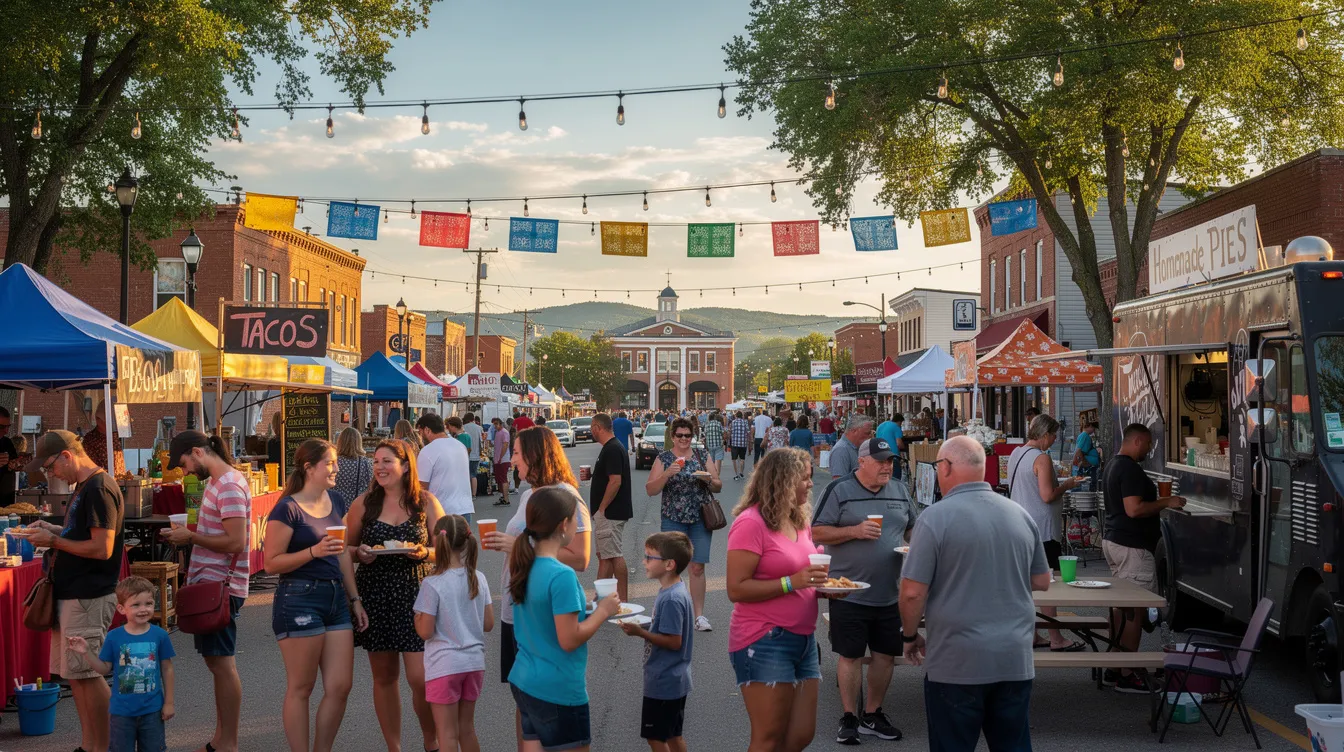
Local events and community connections heavily influence successful email messaging in the South. Subscribers who open tend to click at healthy rates when campaigns feel community-oriented-think church newsletters, real estate alerts, local festival invitations, and hospitality promotions.
Distinct climatic factors dictate product relevancy in email campaigns here. Location based email marketing performs well when tied to:
- Hurricane season prep alerts (Gulf Coast, August–September)
- SEC/NFL sports calendars and tailgate promotions
- Local festivals and tourism peaks
- Real estate market updates in fast-growing Southern metros
Email Benchmarks for the US Midwest
The Midwest-Illinois, Ohio, Michigan, Wisconsin, Minnesota-has strong small-business communities, manufacturing, agriculture, and higher education. These sectors shape the types of email campaigns that perform well.
Directional benchmark guidance:
| Metric | Midwest Range |
|---|---|
| Email open rate | ~40–48% |
| Click rate | ~1.8–2.8% |
| Click-to-open rate | ~6–7% (higher for niche B2B and community sends) |
Manufacturing newsletters, local chamber-of-commerce updates, and higher-ed communications often deliver solid click rates despite modest list sizes. Smaller but more engaged subscriber lists are common here. Value-focused messaging performs best in regions with practical-oriented audiences, and the Midwest is a prime example.
For Midwestern audiences:
- Straightforward email design with clear, effective calls to action outperforms overly flashy creative
- Practical, value-centric email content (how-to guides, local deals, community updates) resonates more than aspirational branding
- VerticalResponse-style templates suit this audience well because they prioritize clarity over complexity
Email Benchmarks for the US West
The Western US-California, Washington, Oregon, Colorado, Arizona-has among the highest iPhone and Apple Mail usage in the country. This significantly inflates reported email open rate because of Mail Privacy Protection, so the highest open rate numbers from this region should be read with caution.
Directional benchmark guidance:
| Metric | West Range |
|---|---|
| Email open rate | ~48–55% (inflated by Apple MPP) |
| Click rate | ~2.0–3.0% |
| Click-to-open rate | ~5–7% (more reliable engagement signal) |
Common industries-tech, startups, tourism, outdoor recreation, entertainment-rely heavily on email automation for product launches, SaaS onboarding, and event promotion. Behavioral triggers in email marketing enhance engagement in tech-savvy regions like these. Messaging tone and cultural references often shift depending on the region’s unique identity, and West Coast audiences tend to respond well to innovation-forward language.
Best practices for the West:
- Advanced segmentation and dynamic content to cut through competitive inboxes
- A/B testing of email design elements frequently
- Focus on click-through rate and downstream conversions instead of chasing open rate
- Automated emails get higher open rates than regular campaigns, making automation workflows especially effective here
Using Customer Data for Location-Based Email Marketing in the US
Location based email marketing means using stable customer data-ZIP code, city, state-to tailor messages, and it differs from real-time geofencing or app-based mobile targeting. Using customer data improves email targeting and relevance without requiring complex technical infrastructure.
Data points to collect from US subscribers:
- ZIP code at sign-up (the single most useful location field)
- State and nearest store selection on signup forms
- Time zone (can be inferred from ZIP)
- Optional preferences: favorite local team, preferred store location, home vs. office
You can capture and manage this data through sign-up forms, surveys, preference centers, loyalty programs, and CRM integrations. Geographic segmentation is heavily used to tailor email campaigns based on local factors, and email marketing software should integrate with other applications for effective segmentation. Regularly capturing insights enhances email list segmentation over time.
On compliance and transparency: clearly state how location data is used for personalization. For example: “We use your ZIP code to send you weather-relevant offers and nearest-store updates.” Federal regulations like the CAN-SPAM Act apply uniformly across the United States, so your opt in process and physical address disclosure requirements remain consistent regardless of region.
Regional Segmentation Tactics to Lift Open, Click, and Click-to-Open Rates
Once location data is collected, email marketers can segment campaigns by US region, state, or city to improve every core metric. The data is clear: segmented emails are 28% more likely to be opened, and personalized emails can increase click-through rates by 14%. Even more striking, segmentation can lead to a 760% increase in revenue when done well.
Tactical segmentation ideas:
- Split your subscriber list by major US time zones (Eastern, Central, Mountain, Pacific) and schedule sends at comparable local hours
- Tailor subject lines with city names-“San Diego summer sale” vs. “Chicago winter clearance.” Personalized subject lines improve open rates by 50%
- Adjust send times to regional work and commute patterns; marketers optimize send times based on local engagement patterns rather than a centralized schedule
- Use dynamic content blocks that swap out regional promotions, local images, or store details within a single master campaign
VerticalResponse’s segmentation and email automation features can automatically route subscribers into the right regional journeys-a Midwest welcome series vs. a West Coast event series-based on stored customer data.
Practical US-Focused Location-Based Email Campaign Ideas
Here are concrete campaign ideas that US small businesses and nonprofits can deploy to capture their audience’s attention and drive traffic:
- Nearest-store campaigns: For retailers with multiple US locations, include maps and local contact details for each region. Highlight a Houston store for Texas subscribers and a Boston store for Massachusetts subscribers. Including store location details boosts email engagement rates and location-based segmentation can drive traffic to physical stores.
- Weather-based offers: Seasonal campaigns must account for distinct regional weather patterns. Promote snow gear for Midwest/Northeast subscribers in January, hurricane prep bundles for the Gulf Coast in August–September, and wildfire/air-quality-related messaging in Western states. Weather-based offers can enhance customer interest significantly.
- Local sports promotions: Tie campaigns to NFL, NBA, MLB, or college football schedules. Using local sports ties can drive traffic to stores, and these campaigns consistently outperform generic promotions in click-through rate.
- Segmented local deals: Segmented emails can alert customers to local deals they actually care about-a tactic that makes sense for any retailer or restaurant chain with regional pricing or inventory.
- Nonprofit event invitations: Invite subscribers to regionally targeted galas, walks, or community events using city-specific landing pages.
Designing and Testing Emails for Different US Regions
Email design preferences can differ subtly by audience and location. A minimalist SaaS-style layout might perform well in San Francisco, while a more visual, promotional design could work better for Florida tourism emails. Testing is the only way to know for certain.
Design approach:
- Maintain a consistent core brand email design across all regions
- Vary elements like hero images (local landmarks, weather imagery), prominence of “Find your nearest location” blocks, and the tone of effective calls to action
- Subject lines between 20 and 40 characters increase open rates by 45%, and using a personal sender name increases opens by 3.81%-test both across regions
Regional A/B testing ideas:
- Compare subject line styles: direct (“50% off in Denver”) vs. curiosity-driven (“Your weekend plans just changed”)
- Test CTA wording per region: “Book now” vs. “Plan your visit” vs. “Shop local”
- Compare layout variations to see which combinations yield higher click-through rate and click-to-open rate in each area
VerticalResponse templates can be duplicated and adapted by region. Centralized reporting lets you compare performance-opens, clicks, unsubscribes-across multiple US segments from one dashboard.
Managing Bounce Rate, Deliverability, and Compliance Across US Regions
Deliverability foundations-list quality, permission-based sign-ups, authentication records like SPF/DKIM, and sending reputation-affect every region equally. But regional list health checks matter because different subscriber populations age and churn at different rates.
Email bounce rate basics:
- Hard bounces (invalid addresses) should stay under 1%
- Soft bounces (temporary issues) are normal but worth monitoring
- A healthy total bounce rate sits under 2–3%
- Older or purchased regional lists tend to spike bounce rate and hurt inbox placement across all your campaigns
Compliance considerations:
- The CAN-SPAM Act requires a physical address and unsubscribe link in every marketing email, regardless of region
- California privacy regulations (CCPA/CPRA) may require extra care when collecting location-specific customer data from West Coast subscribers
- Always honor opt-in preferences and make your unsubscribe process frictionless
List hygiene tactics by region:
- Run automated list-cleaning routines quarterly
- Apply sunset policies for subscribers who haven’t clicked in 6–12 months
- Send re-engagement campaigns with localized subject lines before suppressing inactive contacts-this improves email benchmarks across the board
How VerticalResponse Helps US Businesses Optimize Regional Email Campaigns
VerticalResponse is built for the businesses that this article is written for: US small businesses and nonprofits that need effective, affordable online marketing tools without a steep learning curve.
Core capabilities for regional email marketing:
- Easy list segmentation by state, ZIP code, or custom location fields
- Email automation for region-specific journeys (e.g., a Southern welcome series vs. a Northeast onboarding flow)
- Region-based reporting dashboards showing open rate, click rate, click-to-open rate, and email bounce rate by list segment
- Sign-up forms that capture city and ZIP, landing pages that can be cloned for regional events, and surveys that gather location and preference data
For businesses without in-house marketers, the Pro+ Email Marketing service provides a team that can design, write, and manage campaigns tailored to specific US regions-handling everything from email design to social media promotion alongside your email marketing efforts.
Next Steps: Setting Regional Goals and Running Experiments
Once you understand US regional email benchmarks, the next move is setting realistic business goals for open rate, click-through rate, and click-to-open rate by region and industry. Here’s a simple three-step process:
- Benchmark: Compare your current metrics against the US & Canada baselines and the regional ranges in this article. Use your platform’s reporting tools to break performance down by location segment.
- Prioritize: Choose one or two metrics to improve in a specific region. For example, if your Midwest click rate is lagging, focus your customer acquisition and re-engagement efforts there first.
- Test: Design 2–3 targeted experiments over 60–90 days. Try different subject lines, send times, and types of relevant content for each region. Use purchase history and past engagement data from 2024–2025 campaigns to identify what already works.
Seasonal campaigns must account for distinct regional weather patterns, so build your testing calendar around regional peaks-not just national holidays.
Start by auditing your regional performance inside your email platform today. If you don’t yet have location-based segments, plan your first regionally segmented campaign this quarter. Even splitting your subscriber list into two time zones is a meaningful step toward more emails that actually resonate.
FAQ: US Regional and Location-Based Email Marketing
These questions address practical concerns about US regional email benchmarks and location based email marketing that weren’t fully covered above.
What is a good email open rate and click rate for US small businesses in 2026?
Many US small businesses see a typical email open rate in the high-30% to mid-40% range and a click rate around 1.5–2.5%. Non profits and niche B2B lists frequently exceed those numbers, while large promotional lists from e commerce brands may fall below. The average open rate across all industries in 2025 was 43.46%, and the average click rate was 2.09%.
Because of Apple Mail Privacy Protection, clicks and click-to-open rate are more reliable success indicators than open rate alone-especially in iPhone-heavy regions like the West Coast and major East Coast cities. If your click-to-open rate is consistently above 6%, your email content is doing its job regardless of what your open rate says.
How can I collect location data without hurting my sign-up conversion rate?
Ask for only one simple location field-ZIP code or state-on the main sign-up form. Use progressive profiling through surveys, preference-center updates, or follow-up automated emails to gather more detailed location information over time.
Offer a clear benefit tied to providing location. Something like “Share your ZIP so we can send you local deals and nearest-store updates” keeps conversion rates high while giving you usable customer data for segmentation. This approach respects your target audience while still enabling location based emails down the road.
Should I send all my campaigns at the same time across US time zones?
No. Sending a single blast at 9 AM Eastern means your Pacific time subscribers receive it at 6 AM-before most people are checking their inbox. For critical email marketing campaigns, split sends by at least the four major US time zones (Eastern, Central, Mountain, Pacific) so messages arrive at comparable local hours.
Test different send times per region over a few weeks using your email platform’s reporting to see where open and click-through rate peak, then standardize on those windows in your email automation workflows. Engagement peaks in different regions tend to align with local commuting habits or lifestyle patterns, not a one-size-fits-all schedule.
How often should I clean my regional email lists?
Run list hygiene checks at least quarterly, flagging subscribers who haven’t opened or clicked any email in the past 6–12 months. If you send more emails (daily or weekly), use shorter inactivity windows.
Send a re-engagement campaign by region first-with localized subject lines and offers-before suppressing or removing contacts. This protects your sender reputation, lowers your email bounce rate, and improves all your email benchmarks over time. The effectiveness of your campaigns depends heavily on the quality of your subscriber list.
Do I need different email designs for each US region?
Separate, fully distinct designs for each region are usually unnecessary and hard to maintain, especially for small teams. Instead, use one core, mobile-friendly email design and customize only key elements: hero images, local photos, regional offers, and “nearest location” information.
Dynamic content blocks inside tools like VerticalResponse let you swap regional elements without building four separate campaigns. This keeps your brand consistent while making each send feel locally relevant to your subscribers, whether they’re reading in sales-driven Dallas or services-oriented Seattle.
© 2026, Vertical Response. All rights reserved.





 Features
 Pricing
 Partner
 Blog
 Support
 More resources
 Terms of Services
 Privacy Policy