
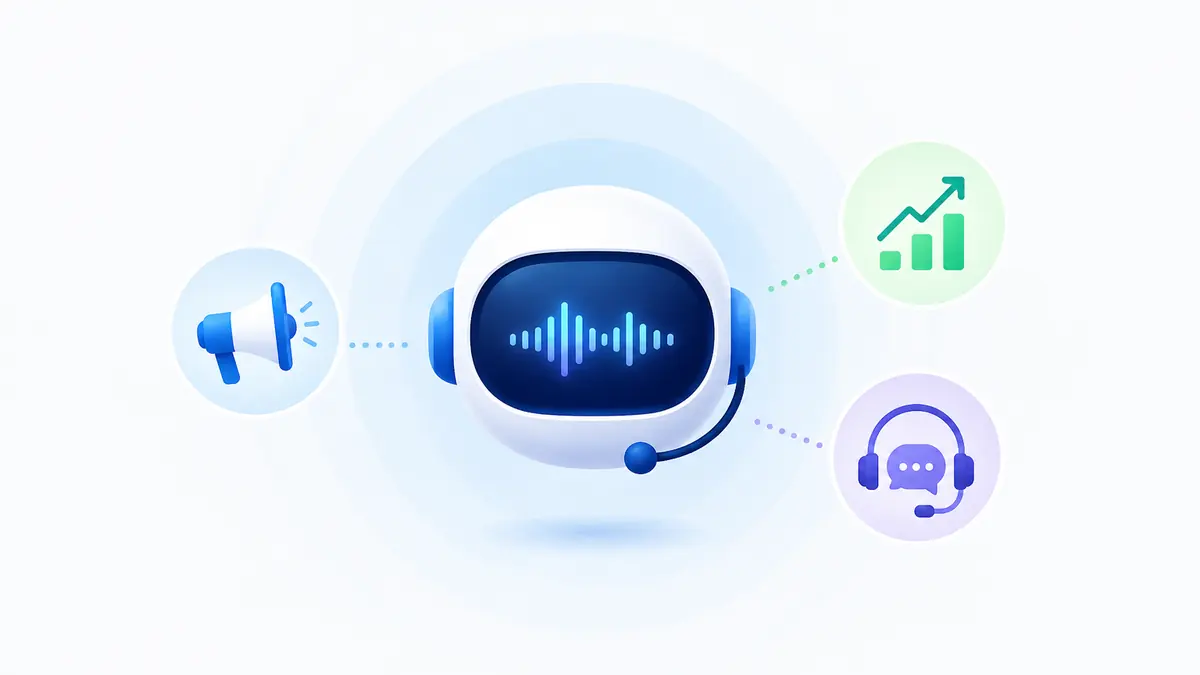
AI Voice Agents: How Voice AI Transforms Marketing, Sales, and Customer Support

Missed calls are missed opportunities. For small businesses and nonprofits, ai voice agents can answer questions, qualify leads, book appointments, and trigger follow-up email marketing without requiring a full call center team. This guide explains how voice AI fits into your marketing strategy, how to measure it, and how VerticalResponse can help connect voice touchpoints with email, landing pages, surveys, and campaign reporting.
Key Takeaways
- AI voice agents are always-on, human-sounding virtual callers that answer and place phone calls using Automatic Speech Recognition, Large Language Models, text-to-speech, and telephony integrations.
- From 2024–2026, voice agents are moving from experimental pilots to core infrastructure for support, lead capture, appointment booking, and outbound campaigns.
- The best results come when ai voice is connected to email marketing, landing pages, online advertising, and other digital marketing channels.
- Small businesses and nonprofits can use voice ai agents for after-hours lead capture, medical appointment reminders, donor renewals, and customer support triage.
- VerticalResponse can act as the marketing automation hub that helps trigger, track, segment, and optimize campaigns that include AI voice touchpoints.
What Are AI Voice Agents?
AI voice agents are software-based “virtual call agents” that can answer and place phone calls in natural language, 24/7. They use artificial intelligence to conduct two-way conversations with humans, helping businesses seeking scalable customer service solutions without adding more phone agents.
A typical call works like this: the caller speaks, and Automatic Speech Recognition converts audio into text for AI voice agents. Large Language Models analyze text to understand intent for AI voice agents, decide what should happen next, and can recall details from earlier in the conversation. Then text-to-speech turns the response into spoken audio, while the system logs actions to a CRM, calendar, support desk, or marketing automation platform.
AI voice agents are different from traditional phone menus because they understand intent, not just button presses. They are also different from chatbots because they handle live calls, interruptions, tone, and urgency.
Key expectations include:
- Natural conversation: AI agents understand intent and handle interruptions during conversations.
- Real-time response: They recognize real-time interruptions using voice activity detection, so callers can interrupt or clarify.
- Always-on availability: AI voice agents can operate around the clock without wait times for customers.
- Scalable service: AI voice agents can handle massive volumes of customer requests simultaneously.
- Multilingual support: AI agents can communicate in multiple languages for a global customer base.
- Action-taking: AI voice agents can perform tasks such as scheduling appointments, creating tickets, routing calls, and updating contact records.
Since around 2022–2025, adoption has grown across SaaS support, local services, healthcare practices, e-commerce order support, real estate, and nonprofit outreach. In many cases, voice ai is becoming a practical service layer, not a futuristic experiment.

Why AI Voice Agents Matter for Modern Marketing Strategy
AI voice agents matter because marketing does not stop when someone clicks an ad or opens an email. They are another channel in the marketing mix, alongside email, SMS, landing pages, social media, search engine marketing, direct mail, and sales promotions.
A marketing plan outlines a company’s advertising efforts, and a marketing plan includes a budget breakdown of costs. Marketing plans should be maintained at least annually, especially as new distribution channels like AI voice become part of modern marketing.
Marketing is defined as creating and exchanging value offerings. The american marketing association says marketing is about creating, communicating, delivering, and exchanging offerings that have value; the AMA reviews its marketing definition every three years, and in 2008, the definition included “society at large.” Philip Kotler defined marketing as engaging customers and creating value, while marketing encompasses activities to promote buying or selling products.
For practical marketing management, AI voice agents support business goals such as:
- Increasing lead capture from campaign-driven calls
- Improving conversion from inbound calls
- Reducing missed calls after hours
- Shortening response times after form fills
- Lowering sales costs and support costs
- Improving customer satisfaction through faster service
Marketing objectives often aim to increase sales by a specific percentage. For example, a home services company might set a goal to increase booked appointments from inbound calls by 25% in Q4 2026. AI voice agents help by answering every call, asking qualifying questions, and routing strong leads to the right person.
This is especially valuable for small businesses and nonprofits. Email marketing is a powerful tool for lead generation, but not every prospective customer wants to fill out a form. Some potential customers prefer to call after reading a campaign email, seeing a landing page, or comparing search results. An AI voice agent can act as a virtual receptionist that turns customer interest into trackable revenue.
They also support inbound marketing. Content marketing attracts customers through valuable content, search engine optimization brings traffic from search engines, and AI voice agents answer questions when prospects are ready to talk. For outbound marketing, compliant reminders, renewals, event marketing follow-ups, and reactivation campaigns can be supported by voice.
The competitive advantage is speed. A 2025 SMB survey reported that 97% of small businesses using AI voice agents saw revenue gains, improved engagement, or stronger industry positioning, though adoption was still uneven. Faster response can help attract customers before slower competitors return a voicemail.
Traditional marketing strategies still matter, including trade shows, direct mail, public relations, physical stores, and word of mouth campaigns. But traditional marketing now works best when connected with digital marketing. Digital marketing includes strategies for internet-connected devices, and AI voice gives those digital campaigns a live conversational layer.
Core Capabilities of AI Voice Agents
Before choosing a voice AI solution, marketers and operations managers should know what to look for. A good system is not just a realistic voice. It needs conversation quality, integrations, analytics, and controls.
Important capabilities include:
| Capability | What to look for |
|---|---|
| Conversation quality | Low latency, realistic voice quality, support for interruptions, and emotionally appropriate tone |
| Operations | Call routing, FAQ handling, appointment scheduling, order-status checks, ticket creation, and structured lead capture |
| Integrations | CRM, calendars, help desks, payment systems, and marketing automation platforms like VerticalResponse |
| Analytics | Call volumes, conversion rates, call recordings, transcripts, sentiment, and containment rate |
| Compliance | Consent flows, recording settings, escalation rules, and guardrails |
Latency should feel natural. Many platforms aim for responses under roughly 500–600 milliseconds, because long pauses make conversations feel awkward. The agent should also match your brand voice, whether that means friendly and casual for a salon, calm and reassuring for a clinic, or professional for B2B sales.
Operationally, AI voice agents automate routine tasks improving customer service efficiency. They can provide consistent service reducing human errors, especially for repeat questions about hours, pricing, locations, appointment availability, return policies, or donation receipts.
For a business using VerticalResponse, integration is the difference between a call and a measurable campaign event. Capturing leads by phone should update the contact list, add tags such as “hot lead” or “needs demo,” and trigger the right email sequence. No code tools and APIs make these workflows easier for teams with limited technical resources.
AI voice agents can reduce labor costs by up to 75% per call in routine support scenarios, but cost effective does not mean fully hands-off. Human escalation remains essential for complex issues, sensitive complaints, or relationship marketing moments where a real person should step in.
Use Cases: Where AI Voice Agents Drive Measurable Results
The clearest benefits show up when AI voice agents are tied to specific, practical use cases.
Inbound lead capture and qualification
A plumber, HVAC company, landscaper, or dental office may receive calls after business hours. Instead of sending callers to voicemail, an AI voice agent can answer, ask 3–5 qualifying questions, book a visit, and sync the details back to the CRM and email list.
One local business case study reported call answer rates rising from about 58% to nearly 100%, with appointment bookings increasing significantly after deployment. For a company focused on increasing sales, that is a direct connection between better service and revenue.
Appointment booking and reminders
Medical clinics and wellness studios can use AI voice agents for new patient intake, pre-visit questions, and automated reminder calls. Healthcare adoption has grown quickly; TechRadar reported that 43% of U.S. medical groups expanded voice AI in 2024, and 70% of those reported measurable operational improvements.
For regulated industries, the workflow should be conservative. Use AI for reminders, directions, basic FAQs, and scheduling before moving into sensitive personal data.
Customer support triage
An e-commerce or SaaS company can use AI to answer common questions such as “Where is my order?” or “How do I reset my password?” The agent can create a ticket, summarize the issue, and route complex cases to live support.
This gives human agents more time for high-value conversations while still improving customer experience for routine requests.
Nonprofit renewals and event follow-up
A nonprofit can use AI voice agents for event registration confirmation, recurring donation renewals, and follow-up calls after a fundraising campaign sent through email and social media.
The important aspect is tone. Nonprofits should avoid sounding like aggressive sales methods. Warm, supportive call flows can reinforce brand identity, brand loyalty, and donor trust.
In every case, the agent should not live in isolation. Voice outcomes should trigger follow-up marketing campaigns in VerticalResponse, update market segments, and inform future personalization.

How AI Voice Agents Fit into Your Digital Marketing and Email Strategy
The strongest approach is to stitch together AI voice, email marketing, landing pages, content marketing, online advertising, and sales follow-up into one coherent marketing plan.
A simple funnel might look like this:
- Ads, seo marketing, content, or search engine marketing attract prospective customers.
- A landing page captures the visitor through a VerticalResponse sign-up form.
- An automated welcome series educates the lead.
- An AI voice follow-up is triggered for high-intent leads or missed calls.
- A follow-up email sequence changes based on the call outcome.
For inbound marketing, educational content and email build trust before a call ever happens. If someone reads a guide, clicks a seasonal offer, and then calls a tracked number, the AI voice agent can answer immediately and log the result.
For outbound marketing, you might send targeted renewal emails, then schedule compliant AI voice outreach to non-openers or non-clickers. A nonprofit could tag “lapsed donor,” while a B2B company could tag “needs demo.” Those tags help determine whether a contact gets a call, an email-only nurture sequence, or a human follow-up.
This supports effective marketing because Understanding your target audience increases marketing effectiveness. A marketing plan should describe your audience in detail, and Market segmentation helps identify distinct groups of buyers. Needs-based segmentation is highly effective for targeting consumers because it groups people by what they are trying to solve, not just who they are.
It also helps keep your messaging consistent. Marketing refers to the work of understanding a target market, creating value, and communicating that value. The Four Ps are product, price, place, and promotion. E. Jerome McCarthy proposed the Four Ps in 1960, and the Four Ps are essential for marketing strategy development.
In this context:
- Product refers to what a business offers to customers.
- Price is the amount charged for a product or service.
- Place involves how products are distributed to consumers.
- Promotion includes advertising and sales strategies.
AI voice can support each part of the marketing mix. It can explain a company’s product, answer questions about setting prices, support products sold through physical stores or online, and help potential buyers understand why customers pay for the service.
Designing AI Voice Experiences: From Market Research to Conversation Flows
Successful AI voice deployments are designed like any effective marketing initiative: grounded in market research, clear personas, and a defined marketing strategy.
Start by collecting information from call logs, surveys, emails, sales notes, and support tickets. Which questions are most common? Which live calls lead to revenue? Which repeat questions consume staff time? This research helps you prioritize the first call flows.
For example:
- A clinic may prioritize appointment requests and insurance FAQs.
- A nonprofit may prioritize event logistics and donation receipts.
- A retailer selling consumer products may prioritize order status and return policies.
- A B2B service business may prioritize quote requests from other businesses.
Then align flows to personas. SMB owners, nonprofit donors, retail customers, and enterprise buyers do not all speak the same way. Your agent’s tone, questions, and offers should reflect the target market and customer expectations.
The agent should have structure and flexibility. Scripts keep the company compliant and aligned with brand voice. LLM flexibility lets the agent handle natural phrasing, interruptions, and unexpected questions.
This is where transcripts become valuable. Review early calls the way you would review A/B tests for email subject lines or landing page copy. If callers repeatedly ask about price, service areas, or product improvement, update the FAQ and email nurture sequence.
Also make sure operations are accurate. If appointment availability, return windows, or donation processing rules are outdated, AI voice agents will amplify those gaps. Product management, service teams, and marketing professionals should coordinate before launch.
A note on creative tactics: guerrilla marketing uses unconventional strategies for maximum impact, and viral marketing encourages sharing to spread messages widely. AI voice does not replace those tactics, but it can help capture demand when a campaign suddenly drives unexpected call volume.
Measurement, Optimization, and Marketing Management with Voice AI
AI voice should be managed like any other channel in marketing management. That means clear KPIs, regular reviews, and budget decisions based on data.
Track these metrics:
- Call answer rate
- Containment rate, or issues resolved by AI without human escalation
- Conversion rate to appointments, sales, donations, or demos
- Average call duration
- Cost per call compared with human phone agents
- Revenue per call
- Customer satisfaction and complaint rate
- Escalation rate to live agents
Connect these numbers to broader organizational objectives. If the goal is lower acquisition cost, compare marketing costs and sales costs before and after AI voice deployment. If the goal is better retention, track renewal calls and follow-up email engagement.
Attribution matters. Use tracked phone numbers tied to specific campaigns, landing pages, or online advertising sources. Then sync outcomes back into VerticalResponse, such as “appointment booked from campaign X” or “donation renewal completed after voice follow-up.”
Review performance monthly. Look at transcripts, objections, dropped calls, and common questions. Then adjust the agent’s questions, offers, and escalation rules.
Revisit the marketing mix quarterly. Decide whether more budget should go to voice, email, ads, direct mail, or search based on real outcomes, not guesses. Modern marketing works best when every channel is measured against the same business goals.
Building a Simple AI Voice–Enabled Marketing Plan
You do not need to automate every phone interaction on day one. A focused pilot is safer and easier to measure.
Step 1: Define concrete business goals
Set one or two goals, such as:
- Increase booked appointments from inbound calls by 25% in Q4 2026.
- Recover 10% of lapsed donors before year-end giving season.
- Reduce missed after-hours calls by 50% in eight weeks.
Step 2: Audit current digital marketing and sales touchpoints
Identify which marketing efforts drive calls. Review email campaigns, landing pages, search results, paid ads, direct mail, trade shows, and referral sources. Find where leads are currently routed and where follow-up breaks down.
Step 3: Choose 1–2 high-impact call types
Start with repeatable, low-risk interactions:
- After-hours inquiries
- Basic FAQs
- Appointment reminders
- Event confirmations
- Quote request intake
Avoid replacing all phone interactions at once.
Step 4: Define the marketing mix for the pilot
Tie the pilot to specific VerticalResponse email campaigns, landing pages with trackable phone numbers, and AI voice agent flows. Make sure the agent collects name, email, phone number, issue, preferences, and consent when appropriate.
Step 5: Launch a 6–8 week pilot
Measure KPIs, gather staff and customer feedback, then decide whether to scale, refine, or pause. Effective marketing builds trust and loyalty with target audiences, so quality matters more than automation volume.
This pilot also supports traditional marketing and digital marketing together. A company promotes offers through many various methods, but AI voice helps turn attention into conversation.
Evaluating and Implementing AI Voice Agents Responsibly
Responsible evaluation matters because AI voice solutions touch real customers and affect brand perception.
When comparing vendors, look at:
- Voice quality and response latency
- Integration with VerticalResponse, CRMs, calendars, and help desks
- Security and compliance controls
- Call recording and consent options
- Vendor transparency
- Human escalation
- Reporting and transcript access
Start with low-risk use cases before moving into billing, disputes, healthcare details, or payment collection. If payments are involved, consider PCI implications. If health-related calls are involved, consider HIPAA-like privacy expectations and vendor safeguards.
Disclose early that the caller is speaking with an AI assistant. Give people a path to human support, especially during business hours. Document what the AI is allowed to say, what data it can access, how long recordings are stored, and how customers can opt out.
Agent assist can also be useful. In an agent assist workflow, AI summarizes calls, suggests next steps, and prepares human staff with context instead of fully handling the call.
VerticalResponse can serve as the stable marketing automation layer around these interactions. Emails, surveys, segments, landing page activity, and call outcomes can stay connected, making long-term relationship building easier to manage.
FAQ
How can a small business afford AI voice agents without a full call center budget?
Most AI voice platforms launched between 2023–2026 use usage-based or per-minute pricing, which makes them more accessible than staffed call centers. Start with a narrow use case, such as after-hours answering or simple appointment booking, and set a modest monthly call cap.
Tie the agent to specific campaigns in VerticalResponse so you can compare incremental revenue from answered calls against the monthly AI cost.
Will AI voice agents replace my human support or sales team?
Usually, no. AI voice agents are best for repetitive, structured conversations such as FAQs, routing, reminders, and simple bookings. Humans remain essential for complex negotiations, sensitive complaints, and relationship-driven sales.
A hybrid workflow is often best: AI handles intake and triage, then passes notes, transcripts, and context to a person.
How do AI voice agents impact my existing email marketing performance?
Voice and email can reinforce each other. Email drives awareness and clicks, while AI voice catches high-intent leads who prefer to call. After the call, VerticalResponse can trigger targeted follow-up emails based on what happened.
For example, a follow-up email that says, “Here’s the estimate we discussed on the phone,” can feel more relevant than a generic nurture email.
What about customer trust-will people be upset talking to an AI instead of a human?
Customer trust depends on transparency and quality. Clearly state that the caller is speaking with an AI assistant, keep the tone natural, and offer a path to a human.
Monitor early transcripts and recordings to find confusion, frustration, or repeated objections. Then refine the script and call flows.
How can nonprofits or mission-driven organizations use AI voice agents without seeming impersonal?
Use AI voice for supportive, non-pushy tasks: event confirmations, logistical reminders, simple program questions, recurring donation renewals, and thank-you follow-ups. Coordinate the tone with email, surveys, and direct mail campaigns in VerticalResponse.
You can also send short follow-up surveys to make sure donors and supporters feel respected and heard.
Conclusion
AI voice agents are becoming a practical part of modern marketing, sales, and service. They help answer calls faster, qualify prospective customers, reduce routine workload, and connect voice conversations to measurable marketing campaigns.
For small businesses and nonprofits, the best starting point is simple: choose one call type, connect it to a clear campaign, measure the outcome, and improve from there. With VerticalResponse as your email and marketing automation hub, AI voice can become another trackable channel for building stronger customer relationships and growing your business.
© 2026, Vertical Response. All rights reserved.





 Features
 Pricing
 Partner
 Blog
Blog Support
 More resources
 Terms of Services
 Privacy Policy