
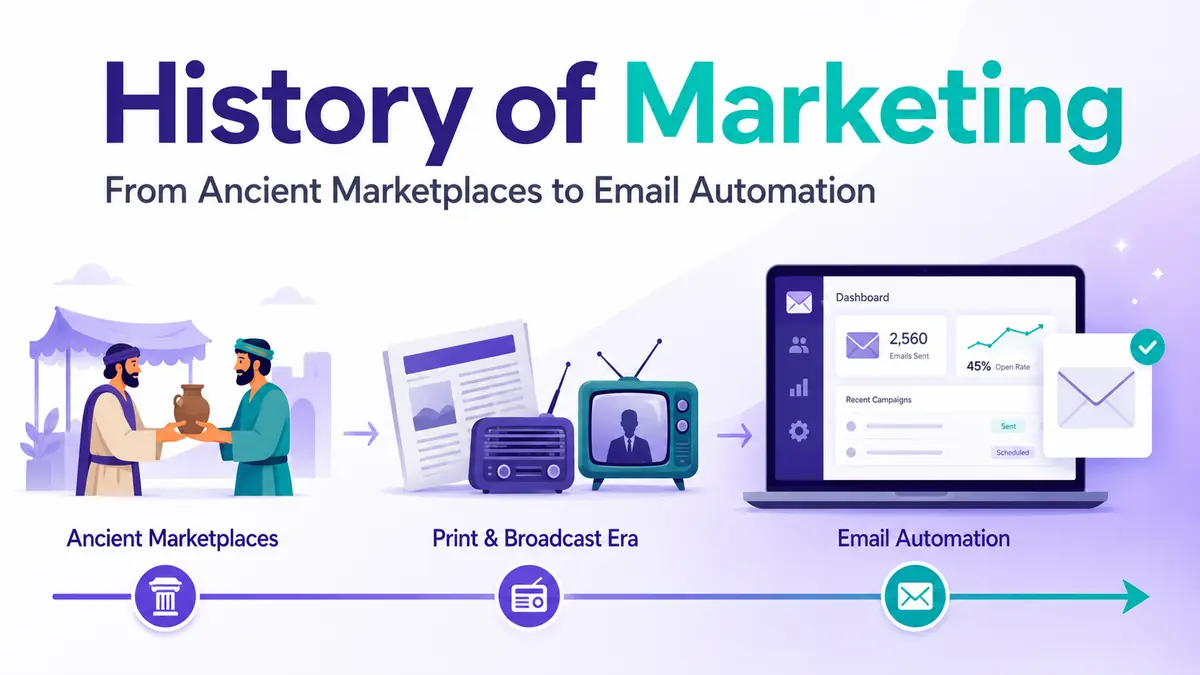
History of Marketing: From Ancient Marketplaces to Email Automation

Key Takeaways
Marketing has evolved from ancient face-to-face bartering to a data-backed global discipline, yet the core principles of trust, differentiation, and audience understanding remain constant. Today’s marketing strategies now combine concepts from various historical eras of marketing, blending ancient wisdom with modern technology.
Here are the most important points from this deep dive into marketing history:
- Mass production changed everything. The Industrial Revolution forced businesses to create national brands, logos, and advertising campaigns to reach distant customers-branding became essential for standing out on crowded shelves.
- Each new medium reshaped the game. Print, radio, television, and the internet each triggered a marketing revolution, expanding reach and demanding new creative approaches.
- Email marketing emerged as a powerhouse channel. From the first commercial email in 1978 to today’s sophisticated automation workflows, email marketing can deliver a return of $10 to $36 for every $1 spent, making it one of the highest-ROI channels available.
- Data and regulation matured together. As data-driven marketing grew, regulations like CAN-SPAM and GDPR pushed marketers toward permission-based, trust-centered practices.
- Small businesses can now access enterprise-grade tools. Platforms like VerticalResponse put advanced features like segmentation, automation, and analytics within reach of organizations that once couldn’t afford full-service agencies.
Understanding marketing history isn’t just academic-it sharpens every email marketing strategy you build today.
Introduction: Why the History of Marketing Matters Today
“Marketing” long predates the word itself. Thousands of years before anyone wrote a subject line or scheduled an automated email, merchants in Mesopotamia stamped seals onto clay, Roman fishmongers inscribed their names on amphorae, and Song dynasty shopkeepers hung printed advertisements in busy streets. Marketing has evolved from ancient face-to-face bartering to a data-backed global discipline, and every modern tactic has roots deeper than most marketers realize.
The practices you rely on now-audience segmentation, brand management, email templates, and marketing automation-didn’t appear from thin air. They’re the latest chapters in a story that runs through print advertising history, broadcast media, direct mail, and the digital revolution. Email marketing is a key component of digital marketing strategies precisely because it inherits and refines lessons from every era that came before it.
This article walks through that story chronologically, from prehistoric trade through today’s AI-powered inboxes. Along the way, we’ll connect each era’s breakthroughs to practical applications for small businesses and nonprofits. If you use a platform like VerticalResponse to run email campaigns, you’ll see how thousands of years of trial, error, and innovation are quietly baked into the tools you open every day.
Each section covers a clear period, concrete dates and examples, and a short note on what today’s email marketing efforts can learn from marketing’s past.
1. Early Roots: Trade, Barter, and Proto-Marketing (Before 3000 BCE)
Before coinage, before written language, and long before anyone coined the term “marketing,” people traded. In Mesopotamia, ancient Egypt, and the Indus Valley, barter economies relied on a basic marketing toolkit: word-of-mouth, reputation, and personal relationships.
Farmers, potters, and weavers differentiated themselves through craftsmanship and reliability. If your grain was consistently clean and measured fairly, neighbors came back. If your pottery cracked, they didn’t. This was an early form of customer relationship management-no database required, but the logic was identical.
Archaeological evidence gives us glimpses of this world. Mesopotamian clay tablets record commercial transactions, complaints about quality, and even disputes over delayed shipments. These are early versions of customer feedback loops, proving that accountability between buyer and seller has always mattered.
The takeaway for today: Even with sophisticated email campaigns and marketing automation, trust and reputation remain your core assets. A subscriber who trusts your sender name will open your message. One who doesn’t will ignore it-or hit the spam button. Basic marketing principles haven’t changed in five millennia.
2. Branding Before Brands: Ancient Markets and Proto-Logos (3000 BCE – 500 CE)
As cities grew in Mesopotamia and across the Mediterranean, permanent marketplaces appeared. With more goods circulating among strangers, producers needed recognizable marks to signal origin and quality.
By the 4th millennium BCE, Mesopotamian merchants used cylinder seals to stamp ownership and origin onto goods. Historians call these “proto-brands” because they functioned like logos-communicating identity at a glance even if their legal and design complexity was simpler than modern trademarks.
Between roughly 1500 and 500 BCE, Mediterranean amphorae carried systematic pictorial markings, shapes, and stamps indicating region of origin, producer, and contents. Even in largely pre-literate societies, buyers recognized quality by shape and iconography alone.

One concrete example: Umbricius Scaurus, a fish-sauce producer in 1st-century Pompeii, inscribed his name and quality claims on amphorae and commissioned mosaics in his atrium depicting his branded products. This was packaging, advertising, and brand identity rolled into one.
These ancient markings parallel the sender names and header logos in your inbox today. Instant recognition heavily influences open rates in email marketing-just as it influenced purchasing decisions at a Roman market stall two thousand years ago.
3. Commerce and Communication in Classical Civilizations
Greek agoras and Roman forums institutionalized buying, selling, and persuasive communication. Street hawkers shouted offers. Public criers announced auctions and events. Wall inscriptions in Roman cities promoted everything from political candidates to gladiatorial games-an early form of out-of-home advertising.
Standardized coinage and weights enabled more complex pricing strategies. Buyers could compare perceived value across merchants, forcing sellers to differentiate on quality, presentation, or persuasion. These are precursors to modern price positioning and sales promotion tactics.
Beyond Europe, ancient Indian and Chinese trade networks carried product reputation across enormous distances. Silk Road caravans didn’t just transport silk and spices-they transported brand stories. A merchant’s word about the quality of goods from a distant city functioned like a referral or testimonial.
Physical presence and repetitive exposure in public spaces-the same merchant in the same stall, the same sign on the same wall-built familiarity and trust. That principle of consistent exposure directly foreshadows how broadcast advertising and later digital impressions work: frequency builds recognition.
4. Medieval Market Towns, Guilds, and Early Retail (500–1500 CE)
The rise of market towns and periodic fairs across medieval Europe created regional hubs for trade. Weekly and seasonal markets were where producers met buyers, and success depended on standing out among competitors.
The word “marketing” itself traces back to this era. Its linguistic roots relate to “going to market”-the physical act of bringing goods to sell in a public place.
Guilds played a critical role in early brand management. By regulating quality standards, training apprentices, and sometimes mandating standardized shop signs (a pretzel for bakers, a horseshoe for blacksmiths), guilds created systems of brand assurance. Customers could trust goods bearing a guild mark.
The period also saw early channel strategy. Permanent shops served local customers, while itinerant peddlers carried goods to remote villages, filling distribution gaps and expanding reach.
Modern parallel: Today’s email marketers still tailor messages by location, language, and availability-segmenting their contact list much like medieval merchants chose different fairs for different goods. Geography still shapes marketing planning, even in a digital world.
5. Marketing in Imperial China and Other Non-Western Traditions
Sophisticated marketing practices developed independently outside Europe. In China, from around 200 BCE onward, merchants used branded packaging for medicines and teas. By the Song dynasty (960–1279 CE), printed advertisements hung in city streets, retail signage was elaborate, and some brands-like the “White Rabbit” needle brand-combined family lineage, imagery, and quality claims into complete brand identities.
Chinese brands often signaled social status, scholarly identity, or imperial endorsement, contrasting with Western emphasis on pure market differentiation. Brand value was tied to cultural prestige as much as product quality.
In the Islamic Golden Age, bazaars thrived on competition, visual display, bargaining, and reputation. Pre-colonial African trade centers along trans-Saharan routes depended on trust, symbolic display, and consistent quality. Specific cloth patterns or trade goods signified origin-functioning as regional brand markers.
Understanding these diverse historical paths matters for today’s digital marketers. Creating culturally sensitive email campaigns and marketing emails across global markets requires awareness that branding, persuasion, and trust operate differently across cultures-and always have.
6. Print, Literacy, and Early Advertising (1500–1700)
The Gutenberg printing press (c. 1440s) was a turning point. For the first time, information could be reproduced at scale. With rising literacy, handbills, broadsides, and flyers circulated across Europe promoting books, medicinal remedies, and local goods.
By the late 1600s and early 1700s, newspapers in London and Amsterdam introduced regular advertising spaces. Merchants paid for announcements of auctions, ships arriving, and goods for sale. Recurring ad formats emerged: standardized headings, pricing, descriptions.
This era saw the earliest experiments with persuasive copy. Sellers used testimonials, appeals to trust, rhetorical flourishes, and simple images-early versions of structured messaging later mirrored in email templates.
Print also introduced the concept of owned media. A merchant who purchased recurring space in a publication had a reliable channel to inform customers, much like a business today that owns its email list. The parallel is direct: an email subscriber list is an owned asset, not subject to the whims of an algorithm.
7. Commercial Intelligence and Consumer Culture (1600–1800)
In the 17th and 18th centuries, European merchants and trading companies began gathering what we’d now call market research. The Dutch East India Company systematically tracked supply, demand, and pricing in distant markets. British merchants compiled data on competitors and consumer preferences. This was commercial intelligence-a precursor to today’s data-driven marketing.
Consumer culture blossomed in 18th-century England. Middle-class buyers purchased decorative goods, fashion items, and luxury products. Shops with display windows, printed catalogs, and seasonal sales emerged. Product differentiation became deliberate: cheaper versions for budget buyers, premium lines for the aspirational.

Merchants also began using circulars and catalogs to reach customers beyond their immediate geography. Early promotional campaigns-seasonal discounts, bundled offers-mirror modern positioning and promotional email campaigns.
The systematic information gathering of this period directly anticipates how marketers increasingly rely on data analytics for monitoring campaign performance and customer behaviour. The tools have changed; the instinct to understand your buyer has not.
8. Industrial Revolution and the Birth of Mass Marketing (1800–1910)
The Industrial Revolution fundamentally reshaped marketing. Mass production, railroads, and telegraph communication enabled national distribution, forcing firms to think beyond local demand. Modern marketing emerged after the Industrial Revolution in Britain and quickly spread across the Atlantic.
Branding became essential with the rise of mass production in the Industrial Revolution. National brands in soap, canned foods, and patent medicines used packaging, logos, and slogans to stand out on crowded shelves. By the late 1800s, lithography firms in the U.S. had grown from roughly 60 companies in 1860 to over 700 by 1890, fueling an explosion of display advertising.
Josiah Wedgwood pioneered direct mail and catalogues in the 18th century, using endorsements, planned production aligned to sales forecasts, and targeted outreach to wealthy buyers. His approach was an early integrated marketing strategy that connected product, promotion, and distribution.
The direct mail catalogs of this era-think Sears, Roebuck & Co.-are direct ancestors of email campaigns. Both rely on curated lists, creative layouts, compelling offers, and measurable responses. The channel changed; the logic didn’t.

9. The Age of Agencies, Research, and Segmentation (1900–1945)
The early 20th century saw the rise of full-service advertising agencies. J. Walter Thompson, founded in 1864 and reshaped by James Walter Thompson after he purchased it in 1878, became a pioneer: offering not just ad placement but creative content, package design, trademark development, and-starting in 1915-a dedicated research department using consumer panels and academic methods.
Formal market segmentation also began in this period. Between 1902 and 1910, researchers like George B. Waldron used census data, tax registers, and directories to classify audiences by income, education, and occupation. By the 1930s, psychographic dimensions-attitudes, values, motivations-entered the picture through the work of researchers like Ernest Dichter.
The University of Michigan offered the first marketing course in 1902, and other institutions quickly followed. The Journal of Marketing launched in 1936, cementing marketing thought as an academic discipline. Between 1900 and 1930, U.S. advertising spending increased approximately tenfold.
These developments laid the groundwork for modern segmentation within email marketing platforms, where marketing teams slice lists by behavior, demographics, and engagement-principles that would have been familiar to Waldron over a century ago.
10. Broadcast Era: Radio, Television, and Emotional Branding (1920–1960)
Radio broadcasting in the 1920s opened a new channel for audio advertising. Companies sponsored entire programs. Jingles, celebrity endorsements, and personality branding became powerful tools for emotional appeal and brand recall.
Television, widespread by the late 1940s and 1950s, combined visuals, sound, and motion. Brands could tell stories, trigger emotions, and build associations at a scale print never achieved. National broadcasting allowed near-simultaneous reach to millions, reinforcing the idea of mass marketing and broad audience positioning.
Early audience targeting emerged through program sponsorship. Shows designed for housewives, children, or sports fans attracted distinct demographics, and advertising slots were priced accordingly. This foreshadowed the audience segmentation that would later become standard in digital marketing and email campaigns.
The creative discipline of copywriting sharpened dramatically. Storytelling, tone of voice, emotional hooks-all refined in this era-continue to inform the structure and tone of high-performing marketing emails today. If you want to write subject lines that get opened, you’re drawing on lessons first learned in radio studios and TV writers’ rooms.
11. The Marketing Concept and Modern Management Thinking (1950–1970)
The marketing concept shifted toward customer orientation in the 1950s to 1980s, redefining business strategy. Instead of asking “What can we make?” companies began asking “What do customers want?”
Peter Drucker argued that the purpose of a business is to create a customer. Philip Kotler later codified these ideas into marketing management frameworks that remain standard in MBA programs and corporate planning. Jerome McCarthy introduced the 4 Ps of marketing in 1960-product, price, place, promotion-giving marketers a practical model for structuring decisions.
The Journal of Marketing, established in 1936, and the American Marketing Association helped solidify marketing as its own academic discipline, distinct from economics or sales. Research methods grew more rigorous: attitude surveys, experiments, motivational research.
These frameworks directly apply to modern digital strategy and email marketing. Every email marketing campaign should align with product positioning (product), pricing promotions (price), distribution channels (place), and the message itself (promotion). The 4Ps aren’t just textbook theory-they’re a checklist for marketing planning.
12. Schools of Marketing Thought and Theoretical Foundations
Early “classical” marketing schools in the early 20th century focused on aggregate flows. The commodity school studied product types. The institutional school examined distribution intermediaries. The functional school mapped marketing activities like selling, transporting, and storing.
In 1957, Wroe Alderson shifted focus toward marketing management, decision-making, and consumer behaviour at the firm level. Later schools integrated behavioral science, psychology, and sociology to understand why consumers choose what they choose-not just what they buy.
Robert Bartels’ 1965 periodisation of marketing thought organized the field’s evolution decade by decade: discovery in the 1900s, conceptual development in the 1910s, integration in the 1920s, specialization in the 1930s, reappraisal in the 1940s, and managerialism in the 1950s and 1960s. This historical research framework remains a standard reference.
These theoretical foundations influence today’s best practices. The psychology behind effective subject lines, the behavioral science that guides segmentation, and the positioning strategies behind your overall marketing strategy all trace back to ideas developed in these schools. Marketing thought isn’t abstract-it’s the invisible architecture of every campaign you send.
13. Direct Marketing, Databases, and Personalization (1960–1995)
Direct marketing’s rise gave businesses a direct line to individual prospects rather than anonymous masses. Postal mail, catalog sales, telemarketing, and loyalty programs proliferated. Lester Wunderman coined the term “direct marketing” in 1961 and innovated loyalty programs and personalized offers.
Companies like Sears built massive mailing lists and customer databases, tracking purchase history, response rates, and seasonal behavior. Recency-frequency-monetary (RFM) models helped marketers identify their most valuable existing customers and predict future purchases-an early form of performance marketing.
Database marketing in the 1980s and early 1990s laid the groundwork for customer relationship management systems and modern marketing automation platforms. Businesses learned that personalized, targeted outreach consistently outperformed generic mass mailings.
The parallels to email marketing today are striking:
- List segmentation mirrors database segmentation by demographics and behavior
- Triggered outreach to inactive subscribers follows the same logic as reactivation campaigns in direct mail
- Tracking conversions per campaign echoes the response-rate tracking of catalog marketers
The email marketing process is, in many ways, direct marketing’s digital heir.
14. Digital Revolution: Web, Search, and Social (1990s–2010s)
The internet fundamentally changed marketing dynamics and consumer behavior. In the 1990s, websites became digital storefronts. Early banner ads introduced the concept of paid advertising online. The Digital Revolution introduced search engine optimization and pay-per-click advertising, giving marketers new ways to reach people actively looking for solutions.
Content marketing emphasized providing value through useful content rather than intrusive advertising. Blogs, white papers, and guides attracted audiences who then became leads-the foundation of inbound marketing.
Social media transformed the relationship between brands and consumers into a two-way communication. Platforms like Facebook, Twitter, and later Instagram gave customers a voice and brands a way to engage customers in real time. This was a genuine marketing revolution: for the first time, advertising became a conversation.
Analytics tools-Google Analytics, web server logs, email open/click tracking-enabled marketers to trace user journeys, measure ROI, and justify investments with concrete key metrics. This period set expectations for measurability and personalization that heavily shape how modern email marketing tools are built and used.
15. A Brief History of Email and Email Marketing
The story of email starts in 1971, when Ray Tomlinson sent the first networked email and introduced the “@” symbol we still use today.
The first commercial email was sent in 1978. Gary Thuerk, a marketer at Digital Equipment Corp, sent an unsolicited message to roughly 400 business prospects via ARPANET. That single blast reportedly generated about $13 million in sales-and immediate backlash. Recipients complained, network administrators banned further mass mailings, and the tension between reach and permission was born.
Email marketing became popular in the 1990s with internet access expanding to homes and offices worldwide. Free email accounts, growing subscriber bases, and low sending costs made email an irresistible channel for businesses of every size.
But growth brought problems. Bulk marketing emails flooded inboxes. Spam complaints surged. ISP filtering evolved to protect users. The era of unchecked email blasting was short-lived, but it established email’s massive potential.

This backlash forced a critical shift: from spray-and-pray mass email to permission-based email marketing. That transition laid the foundation for modern email marketing as a sophisticated, strategic channel.
16. From Spam to Strategy: Regulation, Permission, and Best Practices
Regulatory milestones reshaped the email marketing landscape. The CAN-SPAM Act (signed in December 2003 in the U.S.) established rules for commercial email: no misleading headers or subjects, a valid physical address, clear identification, and an unfettered unsubscribe mechanism. Canada’s CASL followed with stricter consent requirements. Regulations like GDPR have changed how organizations collect and use personal data across the EU, requiring explicit opt-in consent.
These rules pushed the industry toward better marketing practices:
- Use double opt-in to ensure verified email subscriptions
- Include a clear unsubscribe link in every email
- Regularly clean your email list to remove inactive subscribers
- Send confirmation emails to verify sign-ups or purchases
- Segment your audience for personalized messaging
The evolution from one-off blasts to structured email series-welcome flows, nurture sequences, re-engagement campaigns-aligned email marketing with broader digital marketing funnels. Each email became part of a deliberate strategy rather than a random shot in the dark.
Platforms like VerticalResponse bake compliance, list management, and automation into their tools, helping small businesses stay effective and lawful without needing a legal department.
17. The Rise of Email Marketing Tools and Automation Platforms
The 2000s saw the growth of dedicated email service provider platforms that made professional email campaigns accessible to non-technical users. Before ESPs, sending a well-designed email to a large list required coding skills, server management, and deliverability expertise. These platforms changed everything.
Core capabilities that emerged include:
- Drag-and-drop email templates for fast, professional design
- Contact list management with import, export, and segmentation
- Campaign scheduling with timezone optimization
- Analytics dashboards tracking opens, clicks, bounces, and conversions
- A/B testing to optimize subject lines, content, and send times
Email automation transformed the email marketing process by enabling triggered workflows: welcome series for new email subscribers, post-purchase follow-ups, cart reminders, and re-engagement campaigns for people who lose interest. Automated emails run continuously without manual intervention, scaling personalization.
Modern ESPs integrate deeply with CRMs, ecommerce platforms, and social tools, forming the backbone of digital marketing stacks. Integrating with platforms like Salesforce connects email data with sales pipelines.
VerticalResponse fits this evolution as a solution built specifically for small businesses and nonprofits-emphasizing ease of use, automation best practices, and reporting that doesn’t require a data science degree.
18. Email Marketing Strategy in the Context of Modern Digital Marketing
Email marketing sits at the center of today’s multi-channel environment alongside search, social media, content marketing, and paid advertising. But email holds a unique advantage: it’s an owned channel. Unlike social platforms where algorithms control visibility, your contact list belongs to you.
The numbers back this up. As of 2025, there are an estimated 4.5 billion email users worldwide. Email marketing is used by 85% of users on smartphones, making mobile devices a primary reading environment. The channel delivers an ROI of $10 to $36 per dollar spent. Email marketing is 40 times more effective at acquiring new customers than Facebook or Twitter. And email marketing has an average open rate of 19.21%.
A strong email marketing strategy uses different email types for different goals:
| Email Type | Purpose |
|---|---|
| Welcome emails | Introduce new customers to a business |
| Newsletter emails | Highlight new products and include articles |
| Lead nurturing emails | Convert interested audiences into buyers |
| Promotional emails | Maintain product awareness and drive sales |
| Survey emails | Gather customer feedback for improvement |
| Transactional emails | Confirm orders, receipts, and account updates |
Email marketing can increase customer retention by 80%, making it a powerful tool for customer loyalty. Optimize subject lines to improve open rates. Segment your audience for personalized messaging. And keep existing customers informed with relevant emails that deliver genuine value.
For nonprofits, these same strategies apply-whether you’re nurturing donors, engaging volunteers, or promoting events.
19. Brand Management from Logos to Inboxes
Brand management has traveled an extraordinary path: from Mesopotamian seals to guild symbols, from 19th-century trademarks to 20th-century brand personalities, and now to 21st-century digital identities.
The core principle hasn’t changed. Distinctive visual and verbal assets-logos, color palettes, taglines, tone of voice-help brands stand out in crowded markets. What has changed is where consistency must be maintained. Today, brand identity must span websites, social profiles, and especially email templates.
In the inbox, brand consistency matters enormously. Your header logo, footer information, sender name, color scheme, and writing tone all reinforce (or undermine) recognition and trust. A coherent welcome flow that matches your website’s look and voice builds confidence. A jarring, off-brand promotional email erodes it.
Email is one of the most frequent touchpoints between a brand and its audience. Every message is a brand impression. Every design choice signals professionalism or carelessness.
VerticalResponse’s design tools and templates help maintain brand continuity across recurring email campaigns without requiring heavy design resources. You don’t need a creative agency to keep your brand consistent-you need the right tools and the discipline to use them.
20. Data, AI, and the Future of Marketing
Big data, cloud computing, and AI-powered analytics are reshaping how marketing teams make decisions and measure performance. Marketers increasingly rely on data analytics for monitoring campaign performance and customer behavior, turning raw numbers into actionable insights.
AI integration in marketing includes applications for customer segmentation and predictive analytics. In email marketing specifically, current AI uses include:
- Send-time optimization based on individual subscriber behavior
- Predictive segmentation identifying subscribers likely to churn or convert
- Subject line generation using natural language models
- Content personalization at scale, adapting messaging to individual preferences
Consumers increasingly expect personalized marketing experiences as technology evolves. But ethical considerations remain critical: privacy, algorithmic bias, and over-automation can alienate the very audiences you’re trying to engage customers with. Human judgment and creativity are indispensable.

Looking ahead, channels will continue evolving-interactive inbox experiences, tighter integration with SMS and social messaging, smarter automation. But email remains a durable, owned channel. Tools like VerticalResponse’s AI-powered features help small businesses and nonprofits leverage these advances without enterprise budgets.
The lesson from marketing history is clear: technology changes, but the fundamentals don’t. Know your audience. Earn their trust. Deliver value. Measure results. Adapt. Whether you’re stamping a seal on an amphora or crafting a successful email marketing campaign for future campaigns, the playbook is the same.
Understanding marketing’s past-its alternative marketing strategies, its failures, its breakthroughs-gives you a sharper lens for building marketing efficiency into every campaign you send. Start applying these lessons today.
FAQ
This section answers common questions about marketing history and email marketing that weren’t fully covered above.
When did “modern” marketing really begin?
While marketing practices are ancient, many historians see modern marketing emerging between the late 19th and early 20th centuries. The combination of mass production, national brands, full-service advertising agencies, and formal marketing education at institutions like the University of Michigan created a recognizable discipline. The American Marketing Association and academic journals further formalized the field by the 1930s.
How is email marketing different from traditional direct mail?
Both channels share roots in list building, creative layouts, and targeted offers. The differences are speed, cost, measurability, and automation. Email campaigns arrive instantly, cost a fraction of postal mail, provide real-time analytics (opens, clicks, conversions), and support easy A/B testing. Direct mail still has value for tactile impact and reaching audiences without email, but email marketing platforms give small businesses tools that traditional advertising and direct mail can’t match for marketing efficiency and scalability.
What can small businesses learn from historical marketing practices?
Three core lessons stand out:
- Prioritize trust and reputation. Just as ancient merchants depended on personal credibility, your sender name and deliverability reputation determine whether emails reach inboxes or spam folders.
- Differentiate clearly. Proto-brands on amphorae and guild marks on shop signs existed because standing out matters. Your brand identity in the inbox-from design to tone-serves the same function.
- Use data to listen and adapt. From 18th-century commercial intelligence to modern analytics dashboards, the best marketers have always gathered information before acting. Platforms like VerticalResponse make this accessible without specialized expertise.
Why is email still important when social media is so popular?
Email is an owned channel. Unlike social media, where algorithm changes can slash your organic reach overnight, your email list belongs to you. Email consistently delivers higher ROI than social channels, supports direct and personalized communication through relationship marketing, and complements social engagement rather than competing with it. With 4.5 billion email users worldwide and approximately 85% of users accessing email via smartphones, the channel’s reach is unmatched.
How does historical research influence today’s email marketing tools?
Insights from decades of marketing research-on segmentation, timing, messaging psychology, and branding-are built directly into modern platforms. Features like automation workflows draw on direct marketing principles from the 1960s. Template design reflects advertising history’s lessons on visual hierarchy and persuasion. Analytics dashboards operationalize the data-driven marketing approaches that agencies like J. Walter Thompson pioneered over a century ago. When you use tools like VerticalResponse, you benefit from that accumulated knowledge without needing to be an expert in marketing history yourself.
© 2026, Vertical Response. All rights reserved.








 Features
 Pricing
 Partner
 Blog
Blog Support
 More
More Terms of Services
 Privacy Policy