
What Is Agentic AI? A Practical Guide for Marketers and Email Automation Teams

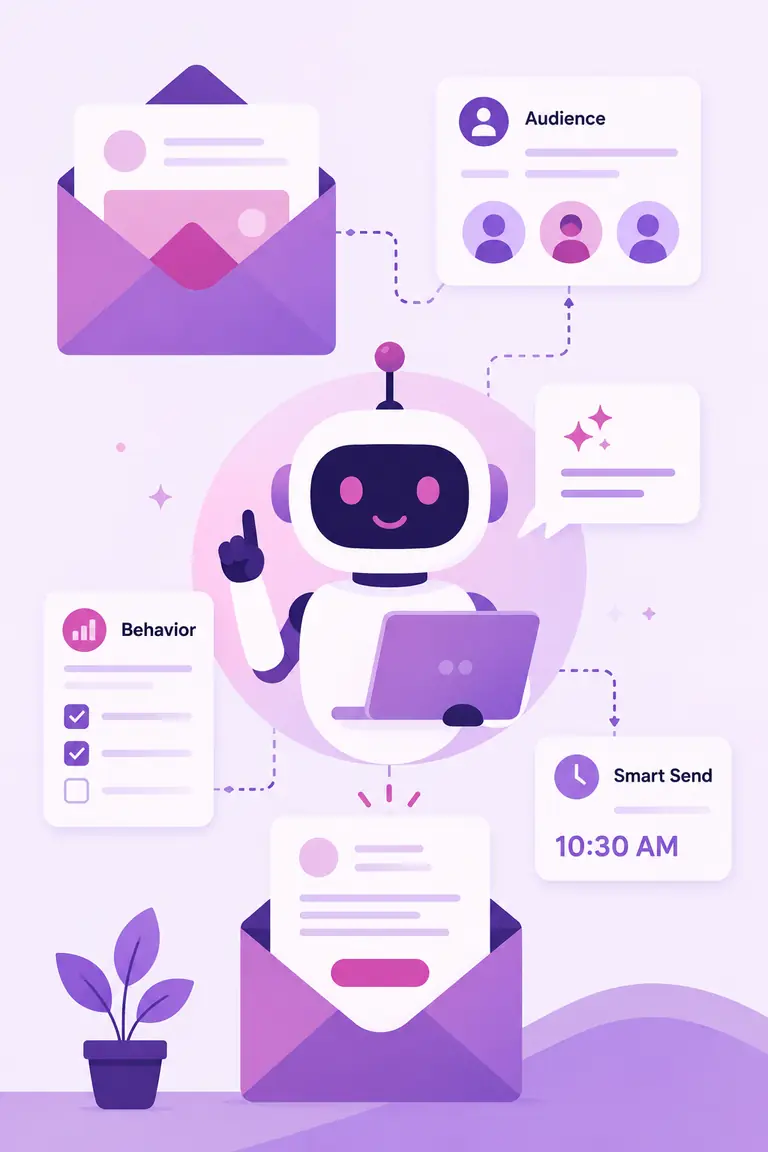
Agentic AI is moving from buzzword to practical tool for marketing teams. Instead of waiting for one prompt at a time, agentic AI can pursue a goal, make decisions, use tools, and improve from results.
For small businesses and nonprofits, that matters because the email marketing process already has many repeatable steps: segmenting lists, choosing a subject line, scheduling sends, reviewing key metrics, and adjusting future campaigns. Agentic AI can help make those steps faster, smarter, and more measurable.
Key Takeaways
Agentic AI refers to artificial intelligence systems designed to act autonomously, pursue high-level goals, and make independent decisions with minimal human intervention.
- Agentic AI goes beyond generative ai because it can perceive data, reason about options, act through tools, and learn from campaign results.
- From 2024 to 2026, agentic ai systems are increasingly being used in digital marketing, email marketing, marketing automation, and customer support workflows.
- Agentic AI builds on large language models, but adds APIs, memory, rules, and feedback loops so ai agents can decide what to do next.
- For small businesses and nonprofits, agentic AI can turn email marketing tools into proactive assistants that segment lists, launch email campaigns, optimize send times, and analyze results.
- VerticalResponse looks at agentic AI through a practical lens: safe, useful support for email marketing, inbound marketing, content marketing, surveys, landing pages, and social media marketing.
What Is Agentic AI? (Quick Definition for Marketers)
Agentic AI is AI made up of agents that can set sub-goals, call tools, and execute multi-step tasks instead of only generating one response. In simple terms, generative AI writes the email; agentic AI can help decide which audience should receive it, when it should go out, how it should be tested, and what should happen next.
Generative AI operates on-demand and requires constant human prompting to function, acting primarily as a tool. Agentic AI acts as a partner rather than just a tool, autonomously completing workflows based on high-level goals. Traditional AI follows strict, pre-defined rules and cannot improvise or handle situations outside its initial design. Agentic systems are defined by autonomy and proactivity, allowing them to operate independently and execute workflows without step-by-step instructions.
Here’s a 2025-style example. An AI email agent notices that open rates are dropping for a newsletter segment. It tests new subject lines, adjusts send times, updates market segments, and reports what changed. The marketing manager does not need to manually reconfigure every rule.
This matters because marketing encompasses more than promotion. The american marketing association defines marketing as the activity, set of institutions, and processes for creating, communicating, delivering, and exchanging offerings that have value for customers, clients, partners, and society at large. The marketing concept emphasizes anticipating and satisfying customer needs more effectively than competitors, which is essential for achieving organizational objectives.
Email marketing is a form of digital marketing that uses email to connect with potential and existing customers, raise brand awareness, build customer loyalty, and promote marketing efforts. Digital marketing encompasses a variety of strategies that utilize online channels to reach consumers, including social media, email, and search engines.
Traditional marketing strategies include methods such as print advertising, television commercials, and direct mail, which were the primary means of reaching consumers before the rise of digital marketing. Modern marketing also includes search engine marketing, search engine optimization, online advertising, event marketing, sales promotions, word of mouth campaigns, and social media platforms.
Agentic AI fits into this broader marketing strategy because it helps marketing professionals coordinate distribution channels, understand customer interest, and inform customers with more relevant promotions.
How Agentic AI Works: The Perceive–Reason–Act–Learn Cycle
Most agentic AI systems follow a loop: perceive, reason, act, and learn. This is not abstract robotics. In marketing, the loop happens through data, tools, decisions, and measurable outcomes.

1. Perceive: collect marketing data
An agent starts by collecting data from your CRM, email marketing platform, website, surveys, and social media. In email marketing, that means opens, clicks, bounces, unsubscribes, conversions, and whether messages land in spam folders.
The agent may also read survey emails, landing page results, purchase history, donation behavior, and google analytics data. Better inputs lead to better decisions.
2. Reason: plan around goals and limits
Next, the agent reasons over a goal. For example:
Increase newsletter click-through rate by 10% in Q3 2026 without increasing unsubscribes.
The agent considers budget, sending limits, brand identity, consent records, marketing budgets, and key performance indicators. It may recommend a different cadence, new segmentation, or a revised email marketing strategy.
3. Act: use tools and integrations
Agentic AI utilizes external tools, APIs, and databases to fetch information and take real-world actions. In a marketing stack, that could mean updating segments, scheduling an email marketing campaign, editing landing pages, triggering confirmation emails, or syncing results with a dashboard.
For a platform like VerticalResponse, this could include using email marketing tools, sign-up forms, surveys, landing pages, and reporting features together instead of treating each channel separately.
4. Learn: improve from results
After acting, the agent studies what happened. One of the key advantages of email marketing is its ability to deliver measurable results, allowing businesses to track metrics such as open rates, click-through rates, and conversions to refine their strategies.
Over time, agents can learn which subject line patterns work, which email subscribers respond to certain offers, and which segments need fewer emails. Context awareness and memory allow agentic systems to retain long-horizon project histories and domain-specific rules over time.
Agentic AI vs. Generative AI: Why the “Agentic” Part Matters
Generative AI can draft a welcome email. Agentic AI can manage the welcome journey. It watches what subscribers do after the first email, updates follow-up messages, tests new send times, and alerts a human when performance changes.
The difference comes down to four practical capabilities.
Autonomy: agents keep working toward a goal after the first instruction.
Tool use: agents can call APIs, update systems, and trigger workflows.
Memory: agents remember past campaigns, approved language, and rules.
Goal orientation: agents optimize for key metrics like open rate, conversion rate, revenue, list growth, or donation volume.
Agentic AI can break down broad objectives into multi-step plans and dynamically adapt its strategy if it encounters errors. For example, if an email campaign gets high opens but low clicks, the agent may test a clearer CTA instead of only changing the subject line.
Modern ecosystems of agentic systems rely on federated networks of specialized agents to handle complex tasks collaboratively. One agent might handle market research, another content marketing drafts, another email scheduling, and another reporting. Together, they support the same marketing plan.
Agentic AI also has applications in various industries, including human resources for managing onboarding, customer support for end-to-end solutions, and finance for algorithmic trading and fraud detection. In marketing, the value is especially clear because digital marketing campaigns produce frequent data that agents can act on.
Core Capabilities of Agentic AI in Marketing and Email Automation
By 2026, the most useful agentic AI capabilities are practical, not futuristic.
Autonomy and proactivity
An agent can identify underperforming marketing campaigns, dormant subscribers, or missed follow-up opportunities. Instead of waiting for a marketing manager to notice a problem, it can suggest a fix or prepare a draft for review.
Tool use and orchestration
An agent can connect your email service provider, CRM, website analytics, e-commerce system, and ad platforms. This helps coordinate marketing channels instead of managing each one manually.
Specialization
Different ai agents can handle different jobs. A segmentation agent may group prospective customers by behavior. A deliverability agent may monitor bounces. A content agent may draft blog post ideas and email copy. A nurture agent may support inbound marketing flows for a specific audience.
Adaptability
Agents can refine personalization, subject lines, timing, and cadence based on live performance. Email marketing allows for automation, enabling marketers to schedule campaigns in advance and send triggered emails based on customer actions, which helps maintain consistent communication with the audience.
Natural-language control
A marketer could say:
Create a three-email series for our July 2026 nonprofit fundraiser and schedule it for best engagement in Pacific time.
The agent then drafts, segments, schedules, and recommends tests while the human stays in control.
Effective marketing strategies can lead to increased sales, brand awareness, and customer loyalty by understanding and meeting the needs of the target audience. Agentic AI helps apply that principle continuously across the product life cycle.
Real-World Use Cases: Agentic AI in Digital Marketing and Email Campaigns
Here are practical ways agentic AI can support small businesses and nonprofits using VerticalResponse or a similar email marketing platform.
Automated lifecycle email sequences
An agent can create welcome emails, onboarding flows, renewal reminders, and win-back campaigns. It can adjust based on whether potential customers click, buy, donate, or ignore messages.
Behavior-based re-engagement
If existing customers stop opening emails, the agent can reduce frequency, test a new offer, or move them into a re-engagement flow. This protects customer loyalty while reducing list fatigue.
Market research agent
A market research agent can scan industry news, competitor newsletters, social media conversations, and search trends. It can suggest content marketing topics, inbound marketing lead magnets, and campaign angles that match your target market.
Email optimization agent
An optimization agent can test subject lines, preview text, CTAs, and segments. It can then sync results into reporting dashboards so marketing teams know what worked. McKinsey has estimated that agentic AI workflows could help organizations accelerate marketing execution and improve growth through more personalized campaigns.
Confirmation and transactional email agent
A transactional agent can create, update, and QA-check confirmation emails, receipts, event confirmations, donation acknowledgments, and password reset messages. This is useful for nonprofits and small businesses because these emails are often opened at high rates and shape trust.
Cross-channel agent
A cross-channel agent can coordinate email marketing, landing pages, social posts, and paid promotion. If google analytics shows that a landing page is converting well, the agent may recommend more email traffic. If social engagement rises around upcoming sales, it may suggest a matching email campaign.

These use cases help teams attract customers, inform customers, promote company’s products, and support selling products without adding unnecessary manual work.
Benefits of Agentic AI for Small Businesses, Nonprofits, and Lean Marketing Teams
Agentic AI can level the playing field. Smaller teams often do not have dedicated analysts, campaign strategists, copywriters, and automation specialists. A well-designed agent can support each role in a narrow, controlled way.
Time savings
Agents can reduce manual list cleaning, segmentation, scheduling, reporting, and campaign QA. That gives small teams more time for strategy, creative work, donor relationships, and business growth.
Performance gains
Best practices for email marketing include optimizing the subscription process, segmenting audiences, crafting compelling subject lines, and ensuring compliance with privacy laws like GDPR and CAN-SPAM. Agentic AI can help apply these best practices consistently, which can also strengthen brand loyalty.
Cost efficiency
Email marketing is considered a cost-effective marketing channel, as it typically costs less than traditional advertising methods while providing a high return on investment when targeting the right audience with relevant messages. Agentic AI can improve that advantage by acting like a virtual analyst and assistant marketer, helping reduce marketing costs and sales costs.
Strategic speed
A business strategy often changes quickly. If customer demand shifts, an agent can surface the change, recommend relevant promotions, and help the company promotes its products or services to the right specific audience.
Competitive advantage
Early adopters can gain a competitive advantage through better timing, more relevant messaging, and faster experimentation. This is especially useful when marketing efforts must stretch across email campaigns, landing pages, surveys, and social media.
Agentic AI does not replace judgment. It helps marketing professionals make more informed decisions faster.
Designing and Governing Agentic AI Systems in Your Marketing Stack
Turning on agentic AI is not only a software decision. It is a marketing management decision involving goals, data, approval flows, and accountability.
Start with your data foundations. Clean contact lists, clear consent records, consistent tags, and reliable analytics are essential. If your data is messy, the agent may make confident but incorrect decisions.
Next, map your workflows. Where should agents help?
- Lead capture forms
- Welcome series
- Newsletter planning
- Promotional blasts
- Re-engagement campaigns
- Survey follow-ups
- Post-purchase or post-donation messages
Then define guardrails. Agents should respect unsubscribe rules, frequency caps, privacy rules, and content approval requirements. Compliance matters under GDPR, CASL, and the CAN-SPAM Act; some teams also refer to this as the can spam act when documenting internal rules. The FTC’s CAN-SPAM guidance is a useful reference for U.S. email requirements.
The shift from “human-in-the-loop” to “human-on-the-loop” oversight allows humans to act as strategic orchestrators rather than performing step-by-step operations themselves. In practice, that means the agent prepares and optimizes, while the human approves sensitive changes.
For example, a nonprofit preparing a 2026 Giving Tuesday campaign might let an agent draft three appeals, segment donors by engagement, and recommend send times. A staff member would still review the message, confirm donation language, and approve the final send.
How VerticalResponse Envisions Agentic AI in Email Marketing Tools
A platform like VerticalResponse can make agentic AI useful by embedding it into familiar workflows instead of requiring small businesses to build custom systems.
Campaign copilot agents could propose subject lines, audience segments, and send times based on historical performance. The goal is to help create a successful email marketing campaign without forcing users to start from a blank page.
Automation architect agents could recommend and build welcome series, onboarding flows, fundraiser sequences, and re-engagement campaigns using drag-and-drop templates plus AI suggestions.
Analytics analyst agents could monitor open rate, click-through rate, unsubscribe rate, conversions, and revenue. Instead of only showing numbers, the agent could explain what changed and recommend the next A/B test.
Cross-feature personalization agents could use survey responses, landing page behavior, and social media engagement to personalize both promotional and transactional messages.
The key is control. Marketers should review, approve, edit, and adjust recommendations through an intuitive interface. Agentic AI should reduce repetitive work while keeping brand identity, compliance, and customer trust in human hands.
Risks, Limitations, and Best Practices for Safe Agentic AI Adoption
Agentic AI is powerful, but it needs boundaries.
The main risks include off-brand messaging, over-emailing, incorrect personalization, data leakage, and agents offering discounts or incentives that hurt margins. An agent should never be allowed to escalate offers, change legal language, or email suppressed contacts without rules.
Use clear objectives and guardrails:
- Define key performance indicators before launching.
- Set sending limits by segment.
- Create forbidden topics and claims.
- Require human review for legal, donor, crisis, or high-visibility emails.
- Log every agent action for audit trails.
- Monitor anomalies such as sudden unsubscribe spikes.
Also maintain version control for templates, review prompts regularly, and audit system instructions. Start with narrow, reversible tasks such as subject line testing or send-time optimization before expanding to multi-agent orchestration.
For small businesses and nonprofits, a responsible vendor like VerticalResponse can help offload complexity around infrastructure, security, monitoring, and usability.
Getting Started: A Step-by-Step Path to Agentic AI in Your Email Strategy
You do not need deep AI expertise to begin. You need clear goals, clean data, and a willingness to test safely.
Step 1: Audit current workflows
Look for repetitive tasks: list segmentation, monthly newsletters, confirmation emails, follow-up reminders, survey emails, and campaign reporting.
Step 2: Define goals and KPIs
Choose simple targets such as open rate, click-through rate, donation volume, list growth, or revenue per campaign. Set a time frame, such as Q4 2026.
Step 3: Choose one starting agent
Start with a narrow use case, such as subject line optimization, send-time recommendations, or re-engagement targeting.
Step 4: Connect key data sources
Connect your email marketing tools, CRM, website analytics, survey data, and google analytics reporting so the agent can see the customer journey across marketing channels.
Step 5: Run pilots and iterate
Compare agent-assisted campaigns against control groups. Refine prompts, rules, segments, and automations based on measurable results.
It also helps to understand the broader marketing foundation. The marketing mix is a foundational tool used to guide decision making in marketing, representing the basic tools that marketers can use to bring their products or services to the market. The 4 Ps of marketing-Product, Price, Place, and Promotion-are essential elements that collectively make up the marketing mix necessary for marketing a product or service.
The concept of the 4 Ps was first proposed in 1960 by E. Jerome McCarthy, who presented them within a managerial approach that covered analysis, consumer behavior, market research, market segmentation, and planning. The ‘Product’ aspect of the marketing mix refers to the item or items a business plans to offer to customers, which should fulfill a market need or demand. ‘Price’ in the marketing mix encompasses the amount a company charges for a product, considering factors like unit costs, marketing, distribution, and competitor prices to ensure competitiveness. ‘Place’ refers to the distribution of the product, addressing how the product and/or service are made available to customers through various channels, whether physical or digital.
Agentic AI does not replace these basics. It helps execute them more intelligently across modern marketing and traditional marketing channels. It can even support unconventional tactics like guerrilla marketing, which is an unconventional marketing strategy that aims to create memorable experiences for consumers, often using low-cost tactics to achieve high-impact results.
FAQ: Agentic AI for Marketing and Email Campaigns
How is agentic AI different from traditional marketing automation?
Traditional marketing automation follows rigid workflows, such as “three days after signup, send Email B.” Agentic AI can adjust steps dynamically based on real-time data.
For example, an agent might change email frequency, propose a new segment, or recommend different content when engagement drops. Platforms like VerticalResponse can blend stable automation with agentic optimization.
Do I need in-house data scientists to use agentic AI in my email marketing?
Most small businesses and nonprofits will not need in-house data scientists if agentic features are built into a user-friendly platform.
Your main jobs are setting goals, reviewing suggestions, approving campaigns, and making sure the agent follows your marketing strategy. The software should handle the technical complexity.
Can agentic AI help with compliance and consent management in email marketing?
Yes, if it is designed properly. Agents can monitor consent flags, unsubscribe events, bounce records, and suppression lists to help keep campaigns compliant with CAN-SPAM, GDPR, and CASL.
However, final legal responsibility remains with the business. Humans should still review policies, approval flows, and automation rules.
What kinds of marketing data should I connect to get value from agentic AI?
Start with email performance metrics, website behavior, CRM records, survey responses, store data, donation data, and google analytics. Richer, cleaner data helps agents make better decisions about timing, content, and audience selection.
You do not need to connect everything on day one. Start with email and web analytics, then expand gradually.
How can I maintain my brand voice when using agentic AI for content and emails?
Create clear brand voice guidelines and provide examples of approved emails. Require human review for new templates, major announcements, fundraising appeals, and sensitive communications.
Over time, agents can learn from approved VerticalResponse campaigns and better match your tone, offers, and audience expectations.
Conclusion
Agentic AI is not just another content generator. It is a new layer of marketing automation that can plan, act, and learn across email marketing, content marketing, inbound marketing, and digital marketing campaigns.
The best starting point is simple: choose one workflow, define the result you want, add guardrails, and measure what happens. With the right email marketing platform and a clear marketing plan, agentic AI can help lean teams move faster while staying in control.
© 2026, Vertical Response. All rights reserved.




 Features
 Pricing
 Partner
 Blog
Blog Support
 More resources
 Terms of Services
 Privacy Policy